Tuesday, June 23, 2015

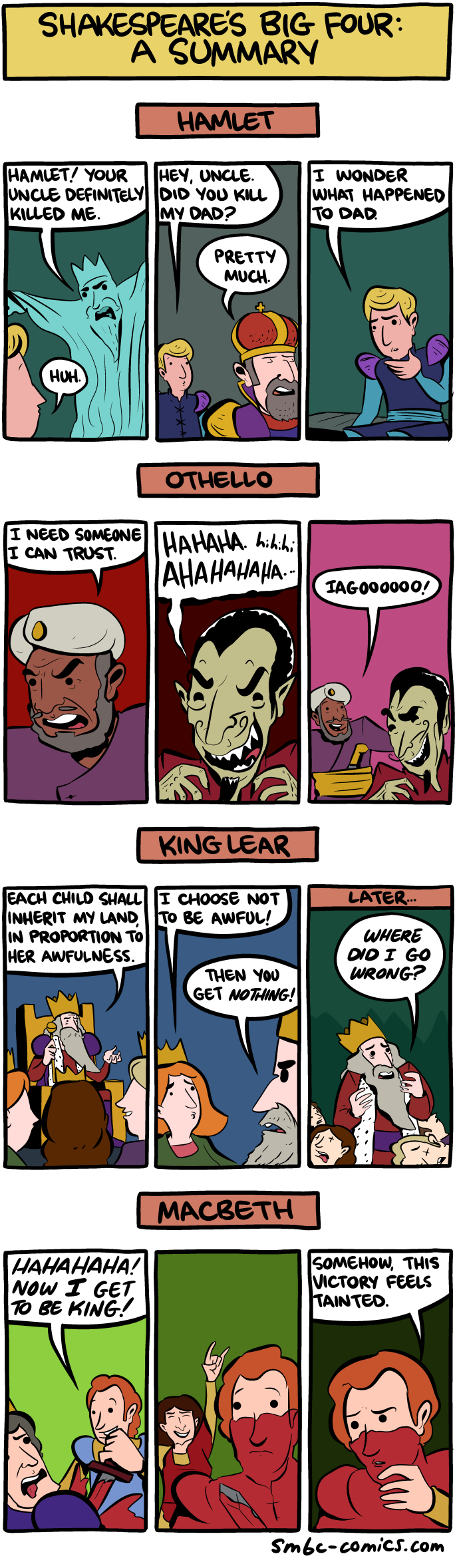
A couple comics from SMBC

I've linked to some stuff from Zach Weiner the guys at Saturday Morning Breakfast Cereal before (here, here, and here).  Click on the images to go to the comic page on their website, featuring alt text and a bonus panel (click the red button to the lower right of the image).  


Monday, June 22, 2015

From Page to Screen to Screen: Hemingway's "To Have and Have Not"

THE NOVEL:


To Have and Have Not was Hemingway's third novel, released in 1937, between two of his major works (A Farewell to Arms and For Whom the Bell Tolls).   It's main character is Harry Morgan, a captain of a small boat in the Florida Keys and Cuba who makes a living chartering the wealthy for fishing trips.  Short on cash after being stiffed his payment by a client, Morgan agrees to smuggle some Chinese immigrants from Cuba to the US.  He tries to prevent Eddie, a rummy and his first mate, from going with him, but he sneaks on to the ship anyway.  Thinking he'll be double-crossed after loading the immigrants on his boat, Morgan kills the man who hired him and then leaves the Chinese on the shores in Cuba.

Times being tough, Morgan takes to running rum from Cuba to the US, and on one trip he and another mate, Wesley, are shot by the Cuban patrol.  Harry loses his arm and his boat is confiscated.  The novels shifts at this point, Harry's relationship with his wife is delved into, his troubled relations with the wealthy inhabitants of the Florida keys, a few of whom temporarily become main the focus of the book.  Hemingway swaps narrators and focuses on the Haves instead of the Have Nots for quite a while, before going back to Harry Morgan, who's agreed to steal back his boat and run some Cuban bank robbers back to Havana, but things don't go as planned.  The robbers kill Morgan's friend Albert and in the ensuing drama, a shootout leaves all the boat's occupants dead, including Morgan.

This is one of Hemingway's more marginal novels, along the lines of Across the River and into the Trees, and is in fact better known for the first of it's film adaptations.  The novels changing narrators and roving focus is a questionable choice, and has garnered divisive reviews.


THE FILMS:

To Have and Have Not (1944)


Length: 100 minutes
Director: Howard Hawks

To Have and Have Not is a classic of the Hollywood golden age.  Humphrey Bogart plays Harry Morgan, a captain of a charter ship in Martinique, a French colony in the Caribbean now under Nazi rule.  Morgan is no fan of the Nazis, but he remains staunchly apolitical.  Morgan and Eddie, played here as pure comic relief by Walter Brennan, turn down a job smuggling French resistance fighters into Martinique.  At the hotel bar, Morgan notices a young woman pick-pocket his charter's wallet (said charter owed him a little under a thousand dollars, and claimed he'd need to cash a check the next morning).  Morgan confronts the girl, and discovers that the charter had nearly two grand in cash and traveler's checks, as well as a plane ticket out of Martinique for the next morning.  The woman introduces herself as Marie Browning (Lauren Bacall, in her first film role), and together they confront the charter.  But the revolutionaries are attacked in the hotel bar, and the charter catches a stray bullet.  Morgan is questioned by the Gestapo and has his money confiscated.  In need of cash, he agrees to help the French resistance fighters.  As the film goes on, his relationship with Browning and desire to help the resistance grows.  The film also has an affable bar singer/pianist.

If the plot sounds a bit like Casablanca, that's because it is.  Casablanca was a big hit, and the studios wanted to strike while the iron was hot.  What's especially interesting is that one of the screenwriters was William Faulkner, who was not Hemingway's biggest fan.  I can't imagine it caused him much heartache to cut a lot of the Hemingway from To Have and Have Not.


The Breaking Point (1950)


Length: 97minutes
Director: Michael Curtiz

The Breaking Point stars John Garfield as Harry Morgan, a charter boat captain who ferries between Newport, California and Mexico.  His charter has them take him and a young, beautiful woman to Mexico.  The woman, Leona Charles (Patrice Neal), attempts to seduce Morgan, but is rebuffed.  After the charter strands Morgan, Leona, and Morgan's mate Wesley in Mexico, Morgan agrees to smuggle some Chinese immigrants aboard his ship.  When the man who hired him tries to double cross him, Morgan kills him and dumps his body in the ocean before releasing the immigrants on the Mexican coast.  When he gets back to California, he finds that one of the immigrants identified his boat, and it's being confiscated by the coast guard.

Morgan's relationship with his wife Lucy (Phyllis Thaxter) and their two daughters is a major part of the novel, and the relationship is fantastically complex.  Not melodramatic, mind you, but they clearly love each other very much but have their own issues and insecurities, and his continuing friendship with Leona Charles throws a small wrinkle into things.

Morgan finds out that the boat was released due to the efforts of the crooked lawyer that facilitated the deal with the Chinese.  The lawyer blackmails Morgan with the knowledge of the murder, and gets him to ferry some robbers to Mexico.  Morgan decides to double cross the robbers and turn them in for the reward.  Unfortunately, Wesley is on the boat when the robbers arrive, and they kill him.  Some time later, there's a shootout, on the boat, and Morgan is the only survivor, but he'll need his arm amputated.


The Gun Runners (1958)


Length: 83 minutes
Director: Don Siegel

The Gun Runners stars Audie Murphy as Sam Martin, captain of a charter boat that runs between Cuba and the Florida keys.  He works with an alcoholic first mate named Harvey (Everett Sloane).  A combination of a crooked charter and a gambling problem land Martin in money troubles.  He takes on a man named Hanagan (Eddie Albert) and his beautiful girlfriend Eva (Gita Hall) to Havana for what Martin believes is an affair, but is really a meeting for an arms deal with the Cuban revolutionaries which ends up with Hanagan shooting a Cuban military officer.   When they get back to the keys, Martin tells his wife what happened.  Lucy Martin, played by Patricia Owens, is the perfect wife.  Beautiful, supportive, trusting, their relationship is completely without trouble, despite the obvious troubles in their lives.

Anyway, Hanagan buys the papers on Martin's boat, and forces Martin to smuggle the guns and a revolutionary into Cuba.  When the revolutionary realizes that most of the boxes of guns are empty, Hanagan kills him.  They discover that Harvey had been hiding on the ship, and he jumps overboard when Martin gets them close to a shoreline.  Martin takes a bullet, but kills all the bad guys (which is completely believable; Murphy received the medal of honor for single-handedly holding off an entire company of German infantry).  He picks up Harvey, and the two head home.

Murphy did a lot of Westerns and war movies, and the director is best known for crime/action movies, most notably Dirty Harry and Escape from Alcatraz (although those were after The Gun Runners.  Siegel directed the 1956 Invasion of the Body Snatchers as well as a bunch of crime thrillers with titles like Riot in Cell Block 11, Crime in the Streets, Private Hell 36).  The Gun Runners tries to keep some of this aesthetic, but it's hit or miss.


THE BEST ADAPTATION:

The Breaking Point (1950)


While none of the films go into the rich/poor issue as Hemingway does, The Breaking Point at least attempts to with Leona Charles, the beautiful socialite.  There is much more similarity with the plot of the novel in general, as Garfield is a bit darker than Murphy's Sam Martin, and less of a smooth talking maverick than Bogart's Morgan.  The relationship between Morgan and his wife is complex and sincere, whereas this relationship is absent in To Have and Have Not and drastically simplified in The Gun Runners.


THE BEST FILM:

Tie-
To Have and Have Not (1944)
The Breaking Point (1950)


"You know how to whistle, don't you?"


I know, declaring a tie is a bit of a cop out.  But these movies are both fantastic and I honestly can't choose.  I've already discussed the relationship in The Breaking Point, but I haven't mentioned the incredible chemistry between Bogart and Bacall (who ended up getting married).  To Have and Have Not also has some great music, and fantastic acting.  While The Gun Runners is a solid film, it's not on the level of the other two.  Audie Murphy may have been one of the greatest soldiers of the twentieth century, but Bogart and Garfield are better actors.  These are two very different movies, the former lighter in tone with a strong romantic core, while the latter is darker and morally ambiguous.  Both films had excellent directors, and in an ironic twist, the film that wasn't trying to repeat Casablanca was directed by Michael Curtiz, who directed Casablanca in 1942.


Anyway, check back next week when I'll look at W. Somerset Maugham's The Razor's Edge (1944), and it's two adaptations.

The Razor's Edge (1946) starring Tyrone Power
The Razor's Edge (1984) starring Bill Murray (which is a pretty weird casting decision.  I'm interested to see how it pans out.)


Wednesday, June 17, 2015

On Dream Logic

Writing dreams is tricky, especially if you're trying to capture 'dream logic.'  But what exactly is dream logic anyway?  I was trying to figure this out, when I remembered part of a quote (whose source I don't remember) stating that dreams are completely logical while you're dreaming them and only become illogical when you apply the logic of waking life.  So, if I thought I'd flip that around, and figure out what dream logic was by applying it to waking life.  And that's when I realized that there is no such thing as dream logic, that the entire concept is a misnomer.  'Logic' is rooted in consistency.  Logic doesn't just dictate that 2 + 2 = 4, but that 2 + 2 will always equal 4.  This is not so in dreams.  It's easy to forget that the logic of the waking world is a result of that world.  That is to say, it is consistent because our experiences of it are consistent, and from those experiences we derive logic.  There is no consistency in dreams.   A single dream can contain contradictions, not to mention the contradictions between different dreams.  So what, then is dream logic?   

I think it's first and foremost a sense of credulity.  Within a dream, we may question why or how something is happening, but that it's happening at all, is never questioned.  Perhaps the greatest piece of dream-writing is Carroll's Alice in Wonderland.  Alice questions why and how things happen to her, her changes in size, for example, but she never doubts its possibility.  One incident from the novel that comes to mind is the baby that she rescues from the duchess.  The duchess is filling the house with pepper, and this baby won't stop sneezing.  Alice takes the baby from the house, only to discover that, a ways down the road, it has turned into a pig.  She is surprised that the baby turns into a pig, but she takes it in stride whereas you or I would freak out.  And we'd freak out because it's impossible, because it runs contradictory to everything we know about the universe.  It is, in the simplest sense, illogical.  But, as I mentioned, we derive logic from experience, and we enter each dream, for lack of a less loaded word, in a state of pure innocence, which is to say, zero experience. We derive dream logic from the contents of the dream, and each dream starts from scratch.  Which is all to say that there is no dream logic outside the dream.

Monday, June 15, 2015

An Update

I previously announced that I'd have a serialized work of long fiction that would update on alternating Mondays, but I am very unhappy with how it's been turning out and don't wish to subject you to it as it is.  I have something else planned, so stay tuned.  Sorry for any disappointment.

Thursday, June 11, 2015

What I'm Reading/Watching

The Great Shark Hunt by Hunter S. Thompson:  A collection mostly of his journalism, but with some interviews and other writings as well.

Mission Impossible (1996): I'd actually never seen it before, and I'm honestly pretty ambivalent about  it. 

I've also been listening to the Superego podcast, which is an improv sketch comedy series.

Tuesday, June 9, 2015

Some Clickhole

If you don't know already, clickhole.com is the Onion's response to Buzzfeed.  And, every now and then, they have some great lit-themed posts.  Specifically their advice from eight famous authors and the absolutely hilarious series of letters between Hemingway and Fitzgerald discussing early drafts of The Great Gatsby


Monday, June 8, 2015

From Page to Screen to Screen: Hemingway's "The Killers"

THE SOURCE:

"The Killers" is a short story by Ernest Hemingway first published in 1927 and is part of his series of Nick Adams stories.  Two men in trenchcoats walk into a lunch counter in Summit, Illinois, cynical, condescending men who talk circles around the owner.  They make Nick, who's eating at the counter, go into the kitchen, where he and the cook are tied up while the owner turns away any customers that come in.  They say they're there to kill a Swede named Ole Anderson.  It's nothing personal, mind you. There killing him for a friend.  When it becomes clear that Anderson isn't going to show, the killers leave.  George unties Nick who runs off to warn Anderson.  Anderson, a former boxer, clearly knows that the killers are on their way, but refuses to do anything about it.  Nick returns to the cafe and declares his determination to get out of this town.    

Like the other Nick Adams stories, the theme of disillusionment is major.  There's the cowardice of the cook and owner, the former advising Nick to not get involved at all.  The final lines of the story:  

[Nick Adams says]"I can't stand to think about him waiting in the room and knowing he's going to get it.  It's too damned awful."
"Well," said George, "you better not think about it."

The story also relies on Hemingway's iceberg theory.  It's mentioned late in the story that Anderson "must have got mixed up in something in Chicago."  In the 1920s, the mob was a big deal in Chicago.  When law enforcement started cracking down, many relocated to Summit.  

Overall, this is an excellent piece of minimalist literature.


THE FILMS:

THE KILLERS (1946):


Director: Robert Siodmak
Runtime: 97 Minutes
The movie starts with a fantastic, nearly blow-for-blow adaptation of the original story.  The killers, played by noir character actors William Conrad (the fat man in "Jake and the Fat Man") and Charles McGraw, are sinister and distant in equal amounts.

Nick Adams (Phil Brown aka Uncle Owen from Star Wars) runs off to tell the Swede (Burt Lancaster in his first film role) that two men are out to kill him, but the Swede is resigned to his fate.  

Conrad and McGraw as the Killers


Enter Jim Reardon, played by Edmond O'Brien (The Wild Bunch, Oscar win for The Barefoot Contessa), an insurance investigator.  Nick Adams and the Swede were both employed by the same service station, which gives its employees a small life insurance policy.  While Reardon is going through the Swede's belongings, he finds a green handkerchief with a gold harp embroidered on it. This reminds him of something, but he can't quite put his finger on it.  At the morgue, he sees that the Swede's right hand is busted up, so he figures the guy must have been a boxer.  Thus begins his investigation.  

He discovers that the Swede's name was Ole Anderson, a boxer who turned to a life of crime.  The detective who arrested Anderson was once his good friend, and agrees to help Reardon figure out what happened.  Anderson fell in love with femme fatale Kitty Collins, played perfectly by Ava Gardner (Showboat, On the Beach) and took the fall for her when she was caught with stolen jewelry.  When he got out, he found that she'd gone back to her ex, crime lord Big Jim Colfax (Albert Dekker).  Along with two other established crooks, Colfax and Collins invite Anderson in on the score of a lifetime: A $250,000 daylight robbery. (That's over $3 million adjusting for inflation.)   

For reasons that will become clear later, I have to give away the rest of the plot.  If you'd rather watch the movie before finding out the ending (which I highly recommend), stop reading now, watch the movie, and come back.

Lancaster and Gardner


Reardon recognizes the handkerchief as the mask worn by one of the robbers at the Prentice Hat Robbery.  It turns out that Anderson, believing that the others were going to double-cross him, stole the entire score and, unbeknownst to the rest of the gang, ran off with Kitty, who then ran off with the money.  Reardon has a violent altercation with one of the other criminals, Dum-Dum Dugan (noir character actor Jim Lambert) who is trying to find where the money is and gets Reardon to admit Kitty ran off with it.

Reardon gets in contact with Jim Colfax, who's gone legitimate, and tells him what's happened.  He soon gets in contact with Kitty, who sets him up to be killed, but Reardon manages to get a drop on the killers (who we haven't seen since the opening) and escape.  Reardon goes to Colfax's house where Dugan and Colfax have just shot each other, and we get the final twist:  Kitty was working with Colfax the entire time.  She convinced Anderson to take all the money, so she and Colfax could have it without giving out shares.  

This is a fantastic noir film, with a great plot, solid pacing, and fantastic acting.  It was nominated for four academy awards, including directing and screenplay, but lost out to The Best Years of Our Lives on both.  


THE KILLERS (1964):


Director: Don Siegel
Runtime: 93 Minutes

We start with two mysterious men walking into a school for the blind, looking for a man named Jimmy North.  Someone gets word to North that two guys are after him and they mean to kill him, but North refuses to run.  The two men find North, who offers no resistance when they shoot him.  Or rather, they shake their guns at him, because apparently silencers mean there's no muzzle flash, shells, or any other thing one normally associates with a gun going bang.

We next see the men on a train out of town.  Lee Marvin (The Dirty Dozen) plays Charlie Strom, a grizzled veteran hitman with great screen presence, while Western character actor Clu Galager plays his partner, Lee, a living cartoon character.  

Clu Galager and Lee Marvin


Strom realizes three things.  1. He was paid $25,000 for this hit, when he'd never been paid more than $10,000 2. Jimmy North had been involved in a million dollar robbery and ran off with the money.  3. If North had the money, they would have been asked to lean on him, not kill him.  Therefore, whoever hired him has the money.  And maybe they just oughta get that money for themselves.   

It turns out that Jimmy North (Oscar nominated actor/writer/director John Cassavetes) used to be a racecar driver, so they go to his old mechanic for information.  Fourteen minutes into the movie, we get our first flashback.  The flashback lasts thirty goddamn minutes, and about half of that is driving footage with terrible greenscreen.

Yes, there's a go-kart scene.  No, it never makes sense.


Jimmy North falls for Sheila Farr (Angie Dickinson).  His mechanic keeps claiming that Farr is bad for him, and she'll ruin his focus.  Well, North has a blowout and crashes, leading to a period of hospitalization.  He finds out that Farr is a kept woman, her benefactor being crime big shot Jack Browning (Ronald Reagan).  Now, at the 45 minute mark, we cut back to Strom and Lee, who we haven't seen for two-thirds of the screentime so far.  They find Mickey Farmer (Norman Fell), Browning's right hand man, who tells them what happened next.  This flashback takes another twenty. goddamned. minutes.  Basically, North is washed up, Farr gets him involved as a driver on a big score that Browning is organizing, and North double-crosses the group and makes off with the money.  Now, over an hour and ten minutes into an hour and a half movie, we finally see Strom and Lee again.  They confront Browning, and demand to see Farr.  They go to Farr's apartment, threaten her, and she has a flashback (a mercifully brief five minute one this time) about how she convinced North that the gang was going to double cross him, and how she and Browning took the money and shot him.  The killers leave the apartment building and are shot at. Lee is killed and Strom is hit.  Strom makes his way to Browning's house, where he shoots Farr and Browning before bleeding out.

My god, the pacing in this movie is a wreck.  The inexcusably long flashbacks destroy the pacing for the investigation storyline, and the constant driving scenes destroy the pacing for the rest.  Look, car chases can be fun and exciting to watch.  Driving, on the other hand, is not exciting at all.


There's only one good thing about this movie and his name is Lee Marvin.


Unfortunately, he gets practically no screen time.

THE BEST ADAPTATION:

THE KILLERS (1946)

In addition to a spot on direct adaptation of the story, Burt Lancaster is a solid Hemingway protagonist, the honorable tough man with big feelings.  While in the 1964 version, the sum total of the similarity is two hitmen kill a guy who doesn't resist.  


THE BEST FILM:

THE KILLERS (1946)

It's strange that the movie from the '40s has aged wonderfully while the movie from the '60s is so outdated.  The 1946 version is fantastic.  Pacing, acting, plot, aesthetics.  It's a great film.  The 1964 version?  It's plagued by terrible decisions.  Besides the aforementioned flashbacks and boring driving sequences, perhaps the most unforgivable is Angie Dickinson's character.  In the 1946 version, Ava Gardner is tough, she steals every scene she's in, and you never know where her loyalties lie, or if she even has any.  In both versions, there's a scene when the robbery is being planned.  The femme fatale and the future murder victim flirt, much to the chagrin of the fatale's current beau.  In the 1946 version, Big Jim Colfax threatens to slap Gardner.  Lancaster makes a move but Gardner tells him she can take care of herself.


In the 1964 version, this happens.


Angie Dickinson spends half of her screentime flirting with the male characters, and the other half getting beaten up.  All this does is make her a far less compelling character.  In fact, every character in this version is worse than the 1946 one.


NEXT WEEK:

It's a Hemingway double-header!

We'll look at the 1937 novel To Have and Have Not, and it's three film adaptations:

The Bogart/Bacall vehicle To Have and Have Not (1944)

The John Garfield crime thriller The Breaking Point (1950)

And the Audie Murphy action flick The Gun Runners (1958)