Run Program follows Hope Takeda, who works at a tech company as a lab assistant in an experimental A.I. development program. The job is far less rewarding or stimulating than it sounds. Or rather, it was, before the A.I. escaped. What makes this different from any of the countless "A.I. on the loose" stories is that the A.I. (named Al) is the mental equivalent of a six year old human.* His motives, personality, and intellectual abilities are akin to those of an average first-grader, if the average first grader could control airplanes with his mind and transfer vast sums of money through online banking apps. Unsurprisingly, the government isn't too happy about this, and so begins the quest to locate and contain Al, who has plans of his own, dragging in everyone from disgruntled scientists, surprisingly profound soldiers, and a self-declared genius who has decided to call himself The Voice of Reason.
Run Program is a comedy, though not of the wacky Hitchhicker's Guide variety. To get a feel for Meyer's sense of humor, you can check out his webcomic Basic Instuctions. There's a lot of observational humor, and a lot of that is workplace humor, which isn't for everyone. Really, go check out some of his webcomics. I think that'll be the best indication of whether or not you'll like the book.
* On a side note, the idea of raising an AI from childhood seems to have been getting more popular within SF in the last decade (and was handled extraordinarily well in Ted Chiang's 2010 novella, The Life Cycle of Software Objects). Meyer doesn't go deep into the theoretical or technical background on this, but is more focused on the immediate impact of a child with practically unlimited power, and the odd results of that situation.
Everyone remembers the 1997 modern classic, Men in Black. It ends with agent K (Tommy Lee Jones) asking agent J (Will Smith) to erase K's memory, so he can retire and lead a normal life. The first act of MIB 2 is mostly about undoing the ending of the first film. The movie opens with exposition via a public access quality conspiracy tv show, explaining that an evil Kylothian named Serleena (Lara Flynn Boyle) wants to steal the light of Zartha. It turns out the light is still on earth, and only K knows its location.
There are a lot of problems with this movie, especially the over reliance on comedic relief characters. Remember Frank the pug from the first movie, and how funny that one scene with him was? One scene is really all that you can stand. Likewise the worms, and the two-headed Johnny Knoxville.
Insert your own "pair of boobs" joke here
Also, the product placement is far from subtle.
All that said, Men in Black 2 isn't really that bad. I mean, it's pretty bad, but it's not as much of a trainwreck as I remember it being. I was worried that it would be unwatchable, but much of it is entertaining. It's a big decline in quality from the first film, but not a completely irredeemable one.
Rating: ★★☆☆☆
The Cross Section:
David Cross plays Newton, the conspiracy minded nerd who runs a video rental store and lives with his mom.
This is actually one of the funniest scenes in the movie, which unfortunately does not appear by itself on youtube.
Martin Flam (Ian Roberts), a man who designs food costumes for corporate promotional events, tried to kill himself. He's required to start seeing Dr. Eric Orloff (Matt Walsh, Veep), who drags Martin into his own dysfunctional world. Their first session begins with Orloff dragging Martin to his amateur softball league, where everyone gets arrested after a fight breaks out. Now Martin not only has to deal with the crushing guilt of designing costumes that are dangerous to wear (it turns out eyeholes are important in a costume), but Martin's best friend (a volatile Gulf War vet played by H. Jon Benjamin), Martin's stripper/psych grad student girlfriend (Kim Raver, 24), a new love interest (Amy Poehler) and her jealous and violent ex-NFL ex-boyfriend.
As the poster indicates, the cast is predominately members of the Upright Citizens Brigade, with a brief cameo by Tina Fey and Janeane Garofalo. Beside Martin's straight-man, I don't know if there's any character that couldn't be described as wacky. Fortunately, the cast is talented enough to pull it off.
On a side note, the movie's promotional website is still up, and it absolutely looks like a website made in 2002. The weird thing, though, is that the cast and filmmaker bios have been updated, some as recently as 2012, which makes me wonder who, ten years after the movie was released, went back into the website to make sure the info was up to date.
Rating:★★★☆☆
The Cross Section:
Character/Performance: David Cross plays Dan Wasserman, a flamboyant, terrible playwright, who wants Orloff's praise for his play that premiered at a dinner-and-a-show restaurant. While pretty funny, the character's only trait is his flamboyance, which is only good for so many jokes.
★★★☆☆
Screentime: There's a brief scene in the middle of the movie, and Cross joins the ensemble of supporting characters who team up at the end to save the day.
This is it people, David Cross's time to shine as a leading man. This actually isn't the first time Cross has played the titular Ronnie Dobbs, as he was a recurring character on Cross and Odenkirk's HBO sketch series, Mr. Show (1995-1998). The sketch show origin of the character makes itself felt, as numerous brief sketches are interlaced throughout the film. In fact, the film starts with two sketches, the first a cartoon parodying the famous "Let's All Go the Lobby" bit, where everything, including the toilets, are smiling and anthropomorphic.
The film is then introduced by the "film valedictorian of Hollywood," who later interrupts the film.
We meet Ronnie, a southern redneck who wants to get back together with Tammy (Jill Talley), his ex-wife and the mother of his children (named Little Ronnie, Middle Ronnie, and Little Middle Ronnie). But he ends up getting arrested on an episode of FUZZ (basically COPS), leading Tammy to reject him. Meanwhile, struggling Hollywood producer Terry Twillstein (Bob Odenkirk) discovers that Ronnie has been arrested on FUZZ numerous times, in fact, Ronnie has a unique talent for getting arrested wherever he goes. So Twillstein goes to Ronnie's hometown, and makes a deal with the Sheriff and soon-to-be Governor (M. C. Gainey), to release Ronnie into his custody in exchange for promising that Ronnie will never return to the state. From here we have the rise and fall of a celebrity narrative, frequently interlaced with sketches, ranging from a scene from a Survivor parody to a music video by Cross and Odenkirk's Mr. Show R&B group, Three Times One Minus One:
As much as I enjoyed this movie, it's become a bit dated. When this came out, reality TV as we know it was in its infancy, with only a couple competition shows (most notably Survivor, which gets parodied more than once in Run Ronnie Run) having large audiences. The idea of an entire tv series based around one person doing stupid things was just a funny concept, as opposed to an accurate description of numerous popular programs. A lot of content that was original in 2002 has become so overdone in the last decade and a half that it loses some of its humor.
That said, the movie is a lot of fun, especially if you're a fan of Mr. Show. There are cameos by Jack Black and Jeff Goldblum, and appearances by all the Mr. Show regulars. In addition to a number of actual sketches, much of the movie is structured like a sketch show, with a lot of scenes being somewhat self-contained like the new age therapy session:
\
So if you like good 90s sketch comedy, give Run Ronnie Run a watch.
Rating:★★★★☆
The Cross Section:
This doesn't really apply, as this is probably the only film where Cross is the lead actor. He plays Ronnie Dobbs for the most part, as well as brief stints as other characters (like the R & B singer in the above picture).
As a teenager I watched the first four Scary Movie installments, and I remember thinking that Scary Movie 2 was the worst of the lot. Rottentomatoes suggests I'm not alone in this judgment. (The first four films are rated 53%, 15%, 36%, and 37%, respectively.) The first Scary Movie (2000) brought the genre spoof back into the limelight. While of course genre spoofs existed before (and perhaps hit their zenith with Airplane! (1980)) the modern terrible genre spoofs, from Not Another Date Movie (2001) to Meet the Spartans (2008) owe their existence to the massive financial success of the first installment of the Scary Movie franchise.
The sequel has some of the characters reprising their roles from the first film, which mostly parodied I Know What You Did Last Summer (1997) and Scream (1996). Anna Faris plays Cindy, Regina Hall plays Brenda, Marlon Wayans is Shorty and Shawn Wayans is Ray. This film is largely based on 1999's The Haunting, which was a remake of the 1963 film, which was itself based on Shirley Jackson's 1959 novel, The Haunting of Hill House. Anyway, the aforementioned characters, along with a few newcomers (Kathleen Robertson, Tori Spelling, and Malcolm in the Middle's Christopher Masterson), are college students tricked into helping summon the spirits at a haunted house by the pervy Professor (Tim Curry) and his assistant Dwight (David Cross). Obviously, shit gets out of hand.
What makes this installment so much worse than the others? Well, most of the jokes aren't jokes. There are a couple scenes with an obscene parrot that don't work at all, because what the parrot is saying isn't funny. Jokes about weed can be funny, but instead we're expected to laugh because weed is being mentioned. The creepy butler's gross deformed hand is good for a joke or two, but not for gags that last several minutes.
I have no problem with dumb humor, but there needs to actually be humor in it.
If you want a fun movie that you don't have to take seriously, some of the movies in this franchise are good for that. But not this one.
Rating:★☆☆☆☆
The Cross Section:
Character:★★★★☆
David Cross plays Dwight, the Professor's assistant. While the professor is concerned about making sure there are enough cameras in the sexy co-eds' bedrooms, Dwight is pretty serious about proving the existence of the supernatural. He's wheelchair bound, but determined not to let that slow him down. Whether it's passing out papers or being fellated, he always refuses offers of help by declaring "I can do it myself!" The character is surprisingly fun, and Cross delivers a good character performance.
Screentime:★★★☆☆
Cross gets a good amount of screentime as part of the ensemble cast.
Chain of Fools is a "heist comedy-romance" and the first feature film by the Swedish creative advertising collective known as Traktor. Kresk (Steve Zahn) is a down-on-his-luck barber whose wife just divorced him when into his shop walks Avnet (Jeff Goldblum). Kresk overhears Avnet talking on his cell, admitting that he's the one who robbed the museum the night before, killing two guards and stealing the precious Ming dynasty coins known as the Shiny New Enemies. Avnet tries to kill Kresk, but through the power of slapstick Kresk gets the upper hand and puts a pair of scissors through Avnet's neck. Kresk gets help hiding the body from his friend Andy (David Cross) and the two of them steal the Shiny New Enemies for themselves. Meanwhile, the plot thickens with the introduction of Salma Hayek as Detective Kolko, who's investigating the theft of the coins and falls in love with Kresk, Elijah Wood shows up as Mikey, a teenage hitman who really just wants to make new friends, Paulie, an illiterate mob boss, and Kresk's terrible nephew who promptly swallows the coins.
The characters in the film all seem like suggestions from an improv comedy game, which may also speak to Traktor's history in very short film. Steve Zahn's a suicidal barber, and if you replaced all his lines with "aw, shucks," the story wouldn't change much. Salma Hayek's the cop who was also appeared in Playboy. David Cross wears a "Timber Scouts" uniform throughout the movie, and when we first see him it's at the Timber Scouts store he owns, where he berates a child to tears for not knowing how to tie a box knot before ripping merit badges off the kid's chest. Oddly enough, suicide is a prominent theme throughout the movie. A couple main characters attempt to kill themselves, and it turns out that pretty much everyone had at least one parent take their own life, which makes for a really awkward romantic dinner scene. But through the power of friendship, love, and murdering a bunch of criminals, they all live happily ever after.
The film has a lot of memorable characters, but it's so packed with them that we don't really get as much as we'd like for most of them. Kresk and Det. Kolko's relationship is completely out of nowhere and unbelievable (e.g. "You seem like a nice guy. And your parents killed themselves? So did my dad! I'm in love with you now.") The characters that we get a lot of are two-dimensional, and are probably better suited to sketch comedy than a feature film.
Rating: ★★☆☆☆
The Cross-Section:
Cross, with his history in sketch comedy, is a lot of fun whenever he's onscreen, given his wacky character.
Unfortunately, there are large gaps where the character is not present.
When I mentioned this movie to my brother, he described it as "the first PG-13 VHS our grandma bought for us." I probably haven't seen this since before I was ten. The plot is that a toy company puts DoD weapons intelligence chips into toys, one a set of bizarre looking, but kind and cowardly aliens (the Gorgonites), and the Commando Elite, a set of soldiers that tell us what GI Joe would look like with R Crumb as artistic director.
Alan Abernathy (Gregory Smith) is a troubled teen whose dad owns an old fashioned toy store in a small town. Alan's watching the store, and convinces the delivery guy to give him a set of the new action figures, despite his dad's ban on "war toys." He befriends his neighbor's daughter, Christy (Kirsten Dunst), who wants to buy one of the soldier toys for her little brother. The toys start fighting each other after the store closes, wrecking the place. It's up to Alan to save the Gorgonites and stop the Commando Elite, whose methods quickly shift into Child's Play territory.
There are four credited writers, and it shows. On the one hand, there's the adventure plot of protecting the good toys from the bad toys, which gets way too dark for a PG kids movie, but doesn't allow itself to get as dark as would make sense. There's an attempt to be overtly political, not only with the bad guys being caricatures of the military, but at one point, the lead soldier, Chip Hazard, stands in front of an American flag puzzle, and starts reciting the opening speech from Patton, quickly descending into a jingoistic mishmash of patriotic quotes (e.g. "Ask not what your country can do for you, but regret that you only have one life to give.") At other times it tries to take on a cultural obsession with technology, or the rise of corporations over small businesses, etc. None of these really pan out as well as they could have if the writers stuck to fully developing one theme rather than trying to tackle as many as possible.
If you watched the clip, you may have recognized Tommy Lee Jones' voice. This movie has a surprisingly high profile cast. Besides an early in her career Kirsten Dunst, there's Denis Leary and Phil Hartman, with voice work by not only Jones, but Frank Langella, Ernest Borgnine, Bruce Dern, Harry Shearer, George Kennedy, Cristopher Guest, Sarah Michelle Gellar, and Christina Ricci.
Also, David Cross is in it.
Cross has a bigger part in this than many of the previous films,like Men in Black, where he had only one scene. Wait a second. Small Soldiers is about a group of elite soldiers bent on fighting an alien population, with the soldiers being led by Tommy Lee Jones, which is kind of like Men in Black. Now that I think about it, there's a daisy chain from all Cross's movies up to this point.
In Destiny Turns on the Radio, he's an agent to a singer named Lucille. In The Truth About Cats & Dogs, his only line is as a pet owner concerned about his dog, named Lucille. He only appears on screen briefly, standing next to Bob Odenkirk. In The Cable Guy, both Janeane Garofalo and Bob Odenkirk have appearances. Cross's only line in that movie is "Oklahoma," where he's referring to the musical, not the state. The next movie is Waiting for Guffman, about the production of a musical about small town Missouri, in which Cross plays "UFO Expert," which directly ties in to Men in Black, which ties into Small Soldiers.
Let's see how far down the rabbit hole this line of reasoning will take us in future reviews/
Waiting for Guffman is the second in a series of mockumentaries written and/or directed by Christopher Guest, starting with This Is Spinal Tap! (1984), followed by Waiting for Guffman (1996), Best in Show (2000), A Mighty Wind (2003), and For Your Consideration (2006). Christopher Guest stars in this one as Corky St. Clair, a flamboyant former Broadway actor who had moved to the small town of Blaine, Missouri, and is tasked with writing/directing a new play for the town's sesquicentennial celebration. The cast is comprised of local amateurs (and frequent Christopher Guest collaborators), Dr, Pearl, the dentist (Eugene Levy), Dairy Queen waitress Libby Mae Brown (Parker Posey), and husband and wife travel agents, Ron and Shiela Albertson (Fred Willard and Catherine O'Hara). The style is semi-improvised, and usually played dead-pan in only the way people like Levy and Willard can play it. We also get little glimpses of what life in Blaine is like, which is where we get our scene with David Cross, a UFO Expert.
Among Blaine's major accomplishments is having been the first city to have a UFO sighting, and as Cross tells us, the landing site is interesting because it's a circle whose diameter and circumference change, but the radius always remains the same.
The eponymous Guffman is a broadway big shot who is going to attend the premiere of "Red, White & Blaine," and, if they're lucky, take the show to Broadway. Of course, the play is hilarious (for all the wrong reasons), the actors are awful. Blaine itself, the Stool Capital of America, was founded by a group of a group of settlers heading for California, whose leader convinced them that a random spot in Missouri was right off the Pacific coast. One hundred and fifty years later, many of the performers are still trying to get to California, and Hollywood in particular. Perhaps it's this sense that nothing ever happens in Blaine that makes the title of the film so fitting. The townspeople in Waiting for Guffman, have, in some ways, the same sense of pointless and endless waiting as the characters in Waiting for Godot. And, as opposed to, say, This is Spinal Tap!, there is real heart here, and despite their wackiness, you can't help having a lot of sympathy for the characters.
I'd recommend all of Guest's mockumentaries, and Waiting for Guffman is no exception.
On the occasion of its re-release as an ebook, I was asked to review Dan Wakefield's debut novel Going All the Way. One of the major themes, as the title suggests, is sex, but more specifically in the context of the social milieu of 1950's Indianapolis. In his foreword, Vonnegut compares it to the previous year's best selling novel, Portnoy's Complaint, claiming that though Wakefield's novel has "wider concerns and more intricate characters, the sexual problems are pretty much the same."
Going All the Way focuses on Willard "Sonny" Burns, who starts the novel on a train back to Indianapolis after spending his service in the Korean War in the public information office in Kansas City. On the train home, he meets Gunner Casselman, one of the "big rods" at Sonny's high school in Indianapolis, returning home from the war a hero. Their friendship develops from here, with Sonny, the insecure, out of shape loser who enlisted only to discover that serving in the Korean War was was like "being on a team in a sport that drew no crowds, except for the players' own parents and friends," and, perhaps more distressing from his point of view, that "Korea wasn't the kind of war that got you laid for being in it," now being taken under the wing one of the town's golden boys. But Gunner has started to realize that this golden boy status is meaningless when the society he's in is so limited.
Vonnegut describes the book as "a period piece," which is only somewhat accurate. There are certain plotlines that are very specific to a certain place and time, for example, the huge social stigma about growing a beard, and Sonny's mother shouting "My Sonny shaves, like a good American." But other aspects remain, maybe not to the same pervasive extent of the midwest in the 1950s, Sonny's mother, much to his chagrin, has become a member of the "Moral Re-Armament Movement," and is trying to get him back into the church. This movement, as much interested in complaining about desegregation and social progress as it is in evangelism, can be seen later in Falwell's moral majority, or even today in any number of organizations, usually with the words "family" or "values" in their names. Maybe the two most popular public figures in Indianapolis at this time are Jesus Christ and Senator Joseph McCarthy. As Gunner laments "anything different is pinko. Anything you ask, if you really want to figure things out, that's pinko too." It is in this repressive social setting that Gunner and Sonny try to have an active sex life, which makes for great comedy until the pressure gets overwhelming.
On another level, this book is about a period of aimlessness for people in their twenties, especially when self-discovery and independence are actively hindered, when "anything different is pinko." This isn't a beat novel, though Wakefield had contact with the major beat authors. Rather a novel of disillusionment, detailing the frustration of young men fighting against the hypocrisy and disappointments of their society, realizing that maybe they're wasting time waiting around for "the perfect combination of sex and intelligence that every man is supposed to find, that is his rightful due," It focuses on a period between the clearly marked path of childhood and high school and college, and the rest of adult life. While there is a lot of humor in this book, there is a solid core of angst, which can range from earnest to, well, angsty.
The Cable Guy has a checkered history. Depending on who you ask, it's a massively underrated cult classic, or a complete failure. It was a failure only in the sense that it fell far short of expectations, especially after Carrey's record setting salary (the first time an actor got a $20 million paycheck). It still made money, but wasn't as big a success as his previous films like Ace Ventura, Dumb & Dumber, or The Mask. This is probably because Carrey's character here is much darker than in those movies. He plays the titular Cable Guy, Ernie "Chip" Douglas, who befriends Steven Kovacs (Matthew Broderick). Steven and his girlfriend, Robin (Leslie Mann), have separated after Steven proposed. Steven rents an apartment and his best friend, Rick (Jack Black), suggests he bribe the cable guy for free premium channels. Chip agrees and then tries to become Steven's best friend, taking him on a road trip to a broadcasting satellite. Chip is in every way the over-the-top cartoonish Jim Carrey character, but here his powers are used for evil, as he starts to manipulate Steven's friends and family while further insinuating himself into Steven's life.
This is... funny, I guess?
To be honest, I'm not a huge fan of the Jim Carrey school of comedy. There are a lot of scenes that are funny in his hyperkinetic way, but I think I agree with Doug Walker's conclusion that it is a dumb comedy, albeit a rather clever dumb comedy. Carrey is legitimately creepy, but I don't think he really carries the movie by himself. Broderick is bland, and we never learn anything about any of the other characters. We know absolutely nothing about Robin, for example. In one scene, she is on a terrible date with Owen Wilson, who comes off as an arrogant prick. When he's done talking about himself, he asks her what she does for a living, only to immediately excuse himself to the restroom, promising that he is "really interested." We never find out what Robin does for a living. We actually know more about Steven's brother (Bob Odenkirk), who is only in one scene and is otherwise completely inessential to the plot. Odenkirk isn't the only link with The Truth About Cats & Dogs, as Janeane Garofalo has a cameo as Medieval Times waitress.
Pictured: the most unlikely Hawthorne reference in cinematic history
Cross's role is extremely brief here as well, Credited as Sales Manager, he plays Steven's work friend, who's only line is laughingly repeating a single word from a pitch Steven makes to their boss.
"Oklahoma" - Cross's only line in the movie
The Cable Guy has aged pretty well, and I like it more than other "wacky" Carrey movies, because at least here he's supposed to come across as creepy and awkward. Don't get me wrong, I loved Carrey's performances in The Truman Show, Eternal Sunshine of the Spotless Mind, and Man in the Moon. I just don't like this style of Carrey comedy because it always comes across as all style no substance, what's the weirdest face he can make or how much can he exaggerate this movement. This works great in small doses (like an SNL sketch), but it's never been enough to get me through a feature length film on its own.
So, if you like Carrey's early comedy, you'll like The Cable Guy. Otherwise, it has a bunch of good moments, but I don't think it works as a whole.
Next week, the Christopher Guest mockumentary, Waiting for Guffman (1996)
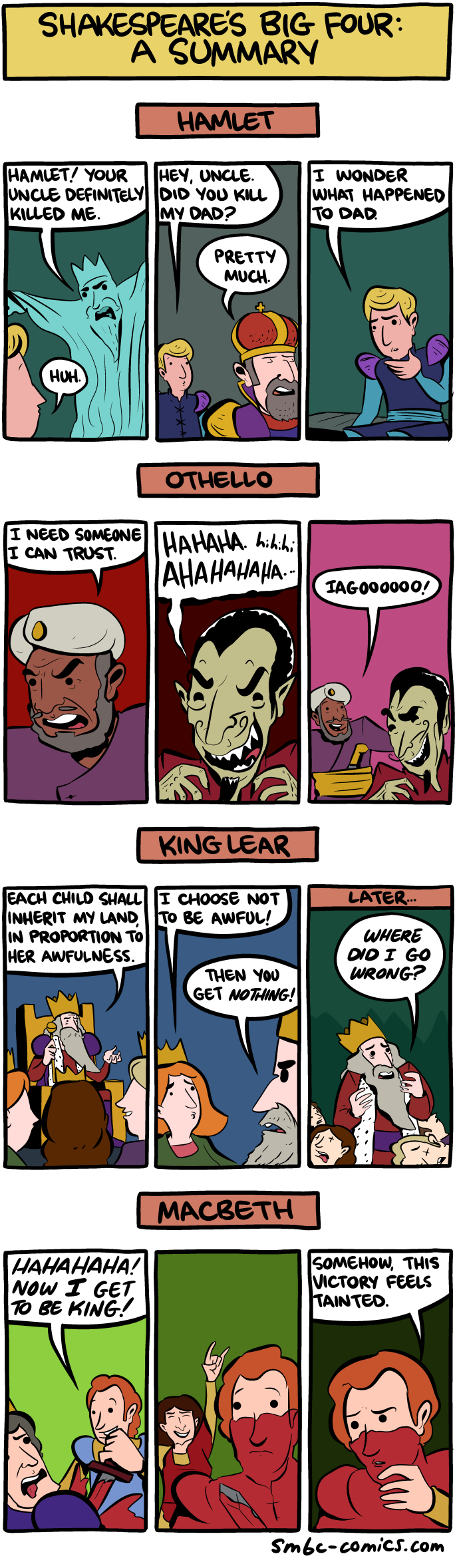
I've linked to some stuff from Zach Weiner the guys at Saturday Morning Breakfast Cereal before (here, here, and here). Click on the images to go to the comic page on their website, featuring alt text and a bonus panel (click the red button to the lower right of the image).
John Grisham (1955- ) was born in Jonesboro, Arkansas, the son of a construction worker. At the age of twelve, his family moved to Southaven, Mississippi. He graduated with a B.S. from Mississippi State University in 1979. He passed the Mississippi Bar exam in 1981, and received his J.D. from the University of Mississippi. In 1981, he married Renee Jones, with whom he had two children.
Grisham began a successful law practice in 1981, starting in criminal law, and moving to more lucrative civil law. In 1984, he was elected to the Mississippi State House of Representatives, a position he held in addition to running his law practice. A case he witnessed while in the state legislature led him to write his first novel, A Time to Kill (1989). He had trouble finding an agent and publisher. He eventually found both, and a limited run of 5,000 copies was printed of his first novel. In 1990, Grisham resigned from his position on state legislature and retired his practice. In 1991, Doubleday published his second novel, The Firm. It was a massive commercial success, as were his third and fourth novels, The Pelican Brief (1992) and The Client (1993). His fourth book, The Chamber (1994) is the first of eleven novels to become the number one annual bestselling novel in the U.S.
Since 1989, Grisham has published a total of 29 novels, five children's books, and a work of non-fiction. His family splits its time between homes in Oxford, Mississippi, Charlottesville, Virginia, and Chapel Hill, North Carolina. Grisham also serves as a board member on the Innocence Project.
The Book:
Length: 366 pages
Subject/Genre: conspiracy/legal thriller
The Brethren is hands-down my favorite Grisham novel so far, and suffers mostly from Grisham's determination to keep much of the novel serious instead of treating it as an all out farce. The basic premise is this: Three corrupt judges in their late middle-age, called the brethren, are inmates at a minimum security federal prison. In addition to operating their own court within the prison, they run a mail scam with the help of an alcoholic attorney on the outside. They take out ads in gay magazines with the intent of blackmailing closeted respondents. I know, this isn't very funny. But then there's the other major plot of the novel. Russia is stepping up its game, and the CIA is worried about a new cold war. They decide they need a president they can count on to give them practically unlimited funding, so they choose an inoffensive unknown congressman from Arizona named Aaron Lake. Now put two and two together, and you end up with the CIA in a battle of wits with some crooked judges, letters get forged, intercepted, and redirected, and the entire weight of United States intelligence gets thrown at finding three people already in custody.
The blackmail and underlying social issues are serious, of course, and I understand Grisham's decision to treat it seriously, but he realizes the comedy in much of the story, and treats it as such, leading to what is often a bumpy transition between humor and drama which rarely works. Maybe I'm just a bit burned out on the rest of Grisham's novels, so one that is sufficiently different from the rest may have an undue luster of originality. If nothing else, it was nice to see a Grisham novel where everyone was running around like chickens with their heads cut off, instead of one guy with a master plan that unravels slowly (slowly, not because the plan requires time, but because he has to hit 400 pages somehow).
I don't know if I'd offer an unsolicited recommendation for The Brethren, but it is certainly one of Grisham's better works.
Bestsellers of 2000:
1. The Brethren by John Grisham
2. The Mark by Jerry B. Jenkins and Tim LaHaye
3. The Bear and the Dragon by Tom Clancy
4. The Indwelling by Jerry B. Jenkins and Tim LaHaye
5. The Last Precinct by Patricia Cornwell
6. Journey by Danielle Steel
7. The Rescue by Nicholas Sparks
8. Roses Are Red by James Patterson
9. Cradle and All by James Patterson
10. The House on Hope Street by Danielle Steel
Also Published in 2000:
The Blind Assassin by Margaret Atwood
True History of the Kelly Gang by Peter Carey
The Amazing Adventures of Kavalier & Clay by Michael Chabon
House of Leaves by Mark Z. Danielewski
A Heartbreaking Work of Staggering Genius by David Eggers
My brother is a senior at NYU's film department, which means it's time for him to make a senior thesis. The senior thesis, like an NYU film degree, is an expensive endeavor. Hence, this humorous video requesting your support!
If this is the kind of film you'd like to see, or you just want to help out some aspiring filmmakers, click on the link below and send a few bucks their way. (And leave a note saying you found out about it through me. Intersibling politics are cutthroat.)
On Monday's post, I included a highlight reel from the recent Dolores Claiborne opera. But don't think that this is the only way modern theater is being strange and wonderful. Just check out New York City's Drunk Shakespeare society:
The Simpsons couch gag has become a pop culture landmark. Although the show creators have kept coming up with original gags for a couple decades at this point, they've invited other writers and filmmakers and artists to take a stab at it, most recently with avant-garde animator Don Hertzfeldt.
The Simpsons couch gag has also played host to cartoonist Bill Plympton:
Graffiti artist Banksy:
And director Guillermo del Toro:
And just in case you didn't get every reference in the del Toro one, watch the next video and everything will be enumerated.
Who?
Booth
Tarkington (1869-1946) appears twice on the list. The first time was for 1915’s The Turmoil. While he had great commercial and critical
success with serious and mature novels (garnering two Pulitzer prizes in the
process), he was also well known for his comedic fiction starring children
and teenagers. Penrod
(1914), which followed the eponymous twelve-year old, was one of his
bestselling books in terms of numbers of copies sold. Both Seventeen and Penrod and Sam(the sequel to Penrod) were
published in book form 1916.
So what's this book about?
Seventeen was originally published
serially in ten parts in Metropolitan
Magazine beginning in January, 1915, before being published as an
individual novel by Harper in 1916. It
tells the story of seventeen year old William Baxter and his summer spent
trying to woo Lola Prat, the girl from out of town who he, and a number of his
friends, have immediately fallen for.
William treats the situation with all the subtlety and rationality one
would expect of a love-struck seventeen year old. His wildly over the top responses to the rest
of the world are hilarious and, as anyone who did not grow up in a cave can
attest, embarrassingly true:
“He walked in his own manner, using his shoulders to emphasize an effect of carelessness which he wished to produce upon observers. For his consciousness of observers was abnormal, since he had it whether any one was looking at him or not.”
The cast
includes bizarre and amusing characters like William’s ten year old sister
Jane, the adventurous, free-spirited bane of William’s existence. And of course, the love interest, the
exasperating Lola Pratt, whose refusal to speak in any fashion other than ‘baby
talk’ straddles the line between humorously annoying and cringe-worthy.
Seventeen is funny, even though at times
the gags get a bit repetitive. But at
185 pages, it doesn’t have a chance to drag.
The humor is largely based on the over-the-top love-strickenness of
William and the overwrought nerves of the adults who have to deal with
them. All this is strung together with a
heaping dose of slapstick.
Why was it so popular?
It
certainly benefited from Tarkington’s popularity and the success of his other
teenager stories. It’s a short, fun read
which would certainly boost its saleability.
On top of that, a silent film version of Seventeen was released in early November, 1916.
So why haven't I heard of it?
Seventeen remained popular for several
decades after its publication. In
addition to the 1916 silent film, the novel was also adapted into a stageplay
in 1918, a short-lived musical (Hello, Lola) in
1926, an Orson Welles radio broadcast in 1938,
a talkie in 1940, and lastly another musical in 1951.
Eventually, Seventeen went the way of the rest of Tarkington’s oeuvre and faded
into obscurity.
Should I read it?
As with The Turmoil, there are aspects of the
story that do not translate well into modern attitudes. Certain subplots (e.g. William’s quest for an
evening suit) are far removed enough from modern culture that they lose much of
their impact. If you can overlook that
and have the patience to deal with Lola’s (intentionally and humorously)
grating personality, I’d gladly recommend it as light, fun reading.
A Portrait of the Artist as a Young Man by James Joyce Chicago Poems by Carl Sandberg
Sources: Mott, Frank Luther. Golden Multitudes: The Story of Best Sellers in the United States. New York: The Macmillan Company. 1947. Tarkington, Booth. Seventeen. New York: Harper & Row. 1968. Woodress, James. Booth Tarkington: Gentleman from Indiana. New York: J. B. Lippincott. 1955.