Wednesday, June 11, 2014
ERB: Stephen King vs. Edgar Allan Poe
Last April, I posted Epic Rap Battles of History's Dr. Seuss vs. William Shakespeare. Well, Nice Peter and Epic Lloyd have done it again, this time pitting Edgar Allan Poe against Stephen King:

Monday, June 9, 2014
1972-3: Jonathan Livingston Seagull by Richard Bach
The Author:

Richard Bach (1936- ) was born in Oak Park, Illinois. In 1955, he attended Long Beach State College (now California State University, Long Beach), before joining the joining the US Air Force as a pilot. In 1957, he married his first wife, Bette Franks, with whom he had six children. (They divorced in 1971.) His first three books were non-fiction works about aviation: Stranger to the Ground (1963), Biplane (1966), and Nothing by Chance: A Gypsy Pilot's Adventures in Modern America (1969).
His first and most popular novel, Jonathan Livingston Seagull, was published in 1970 with only a limited run (the publisher was not optimistic about its success). From here he had a long (and continuing) career in fiction, his next novel, 1977's Illusions: The Adventures of a Reluctant Messiah placing on the top ten annual bestseller's list in 1977 and 1978. Bach has continued writing fiction and non-fiction up to the present, his most recent book being 2014's Illusions II: The Adventures of a Reluctant Student.
The Book:


Bestsellers of 1972:
1. Jonathan Livingston Seagull by Richard Bach
2. August 1914 by Aleksandr Solzhenitsyn
3. The Odessa File by Frederick Forsyth
4. The Day of the Jackal by Frederick Forsyth
5. The Word by Irving Wallace
6. The Winds of War by Herman Wouk
7. Captains and the Kings by Taylor Caldwell
8. Two from Galilee by Marjorie Holmes
9. My Name is Asher Lev by Chaim Potok
10. Semi-Tough by Dan Jenkins
Bestsellers of 1973:
1. Jonathan Livingston Seagull by Richard Bach
2. Once Is Not Enough by Jacqueline Susann
3. Breakfast of Champions by Kurt Vonnegut
4. The Odessa File by Frederick Forsyth
5. Burr by Gore Vidal
6. The Hollow Hills by Mary Stewart
7. Evening in Byzantium by Irwin Shaw
8. The Matlock Paper by Robert Ludlum
9. The Billion Dollar Sure Thing by Paul E. Erdman
10. The Honorary Consul by Graham Greene
Also Published in 1972 & 1973:
Watership Down by Richard Adams
Invisible Cities by Italo Calvino
The Princess Bride by William Goldman
The Stepford Wives by Ira Levin
Child of God by Cormac McCarthy
Sula by Toni Morrison
Zen and the Art of Motorcycle Maintenance by Robert Pirsig
Gravity's Rainbow by Thomas Pynchon
Fear and Loathing in Las Vegas by Hunter S. Thompson
Sources:
Bach, Richard. Jonathan Livingston Seagull. 1970. New York: Avon, 1973. Print.
"Jonathan Livingston Seagull." Roger Ebert Reviews. Ebert Digital LLC. Web.
"Richard Bach." Contemporary Authors Online. Detroit: Gale, 2006. Literature Resource
Center. Web.
Richard Bach (1936- ) was born in Oak Park, Illinois. In 1955, he attended Long Beach State College (now California State University, Long Beach), before joining the joining the US Air Force as a pilot. In 1957, he married his first wife, Bette Franks, with whom he had six children. (They divorced in 1971.) His first three books were non-fiction works about aviation: Stranger to the Ground (1963), Biplane (1966), and Nothing by Chance: A Gypsy Pilot's Adventures in Modern America (1969).
His first and most popular novel, Jonathan Livingston Seagull, was published in 1970 with only a limited run (the publisher was not optimistic about its success). From here he had a long (and continuing) career in fiction, his next novel, 1977's Illusions: The Adventures of a Reluctant Messiah placing on the top ten annual bestseller's list in 1977 and 1978. Bach has continued writing fiction and non-fiction up to the present, his most recent book being 2014's Illusions II: The Adventures of a Reluctant Student.
The Book:
Length: 127 pages
Genre/Subject: Fable/Self-Improvement
Jonathan Livingston Seagull is about a seagull named, well, Jonathan Livingston Seagull. Unlike the rest of his flock, Jonathan loves flying for its own sake. This attitude ends up annoying the flock, who are only concerned with the day-to-day tedium of catching fish, and Jonathan ends up being exiled from the flock. In solitude, he learns to fly faster and higher than any other seagull alive. Then he dies, but he's escorted by two golden seagulls to the next plane of existence. It turns out that there's a reincarnation system, where a love of flying for its own sake gets you to the next level. Eventually, Jonathan learns to fly instantly, to any point in space or time (because the only thing between the rest of the universe and you is your own inhibitions). He decides to go back to the first plane and teach the seagulls there. He becomes a Jesus figure, complete with disciples, raising the dead, and persecution from among his own people.
The whole thing is interspersed with photographs of seagulls. That is to say, there are nearly as many pages of photographs as there are of text.
Bach himself said that there wasn't much of an underlying message to the novel besides to find what you love and go at with everything you've got, but I'm not one for the intentional fallacy. Unsurprisingly, this book has been seen as everything from a simple self-improvement story to spiritual text.
Honestly, to me it seems very dated to the 60s-70s period, with the pseudo-spiritual appropriation of Eastern belief systems (consider popular figures like John Lennon, as well as the resurgence of Siddhartha among young readers, the burgeoning popularity of transcendental meditation, among numerous other trends), combined with a pretty stinted Christian aspect, and a message of 'society just needs to focus on what it loves' message. Don't get me wrong, it seems to be completely in earnest, but I think the entire thing can be summed up in an inspirational poster.
I'm being a bit cynical. Bach, after all, never claimed to be some spiritual leader, and was in fact dismayed at the amount of mail he got from people asking what the novel was really about. Is it any wonder his next novel is about a man who, after being proclaimed a messiah by the public, gets tired of it and starts a career selling biplane rides? I try not to grudge people their joys, and while I may find the novel trite, someone who hasn't been exposed to any of the philosophies above mentioned could find it revelatory.
Jonathan Livingston Seagull's place on this list is interesting for two reasons. 1. It was the bestseller for two consecutive years. 2. It was first published in 1970. Like I mentioned in the author section, the publishers of JLS didn't have much faith in it, and only printed 7,500 copies in the initial run. It became popular quickly, and as the book wasn't immediately available, it became mysterious and desirable. The media kept reporting on its popularity which, in a sort of positive feedback loop, caused it to be more popular, causing more reporting of its popularity, etc. etc. (This is a tried and true technique. Consider the unaccountable popularity of last year's film The Purge. At least the reporters of JLS waited until the book was released to start publicizing it.)
So of course there was a film.
The film used remote control planes designed to look like pigeons for many of the aerial shots, was nominated for best cinematography and best editing, and had a soundtrack by Neil Diamond. Those are the high points. The film was almost universally panned, to quote Roger Ebert:
It is based, to begin with, on a book so banal that it had to be sold to adults; kids would have
seen through it. "The Little Engine That Could" is, by comparison, a work of some depth and
ambition. Consider that the movie made from the book has now been made the object of a
lawsuit by the book's author and you have some measure of the depths to which we sink as
Jonathan dives.
Bach did, in fact, sue Paramount due to the discrepancies between the book and film. It turns out the director had a clause in his contract requiring any changes to be accepted by Bach, which wasn't honored, leading to court-ordered rewrites. Not only did Bach sue, but Neil Diamond sued, claiming that too much of his music was cut from the film. All in all, it was a disaster.
I'm at a loss of who to recommend this book to. Anyone who is reading a lit blog with an emphasis on the history of popular literature will probably be familiar enough with everything in the book to find it pretty lackluster. I rarely use this summation paragraph to recommend other books, but I'm going to do that now. It's Julio Cortazar's From the Observatory (1972). Like Jonathon Livingston Seagull, it's short (in the 100-120 page range) and uses photographs (in this case of a bizarre 18th-century royal Indian observatory). There isn't much of a narrative to it, and it's been called everything from a novel to a book of poetry. As pretentious as it may sound, it's more like a long philosophical musing on man's place in the universe, examined through the constructs of this observatory and the life cycle of eels. It's a pretty neat book.
Bestsellers of 1972:
1. Jonathan Livingston Seagull by Richard Bach
2. August 1914 by Aleksandr Solzhenitsyn
3. The Odessa File by Frederick Forsyth
4. The Day of the Jackal by Frederick Forsyth
5. The Word by Irving Wallace
6. The Winds of War by Herman Wouk
7. Captains and the Kings by Taylor Caldwell
8. Two from Galilee by Marjorie Holmes
9. My Name is Asher Lev by Chaim Potok
10. Semi-Tough by Dan Jenkins
Bestsellers of 1973:
1. Jonathan Livingston Seagull by Richard Bach
2. Once Is Not Enough by Jacqueline Susann
3. Breakfast of Champions by Kurt Vonnegut
4. The Odessa File by Frederick Forsyth
5. Burr by Gore Vidal
6. The Hollow Hills by Mary Stewart
7. Evening in Byzantium by Irwin Shaw
8. The Matlock Paper by Robert Ludlum
9. The Billion Dollar Sure Thing by Paul E. Erdman
10. The Honorary Consul by Graham Greene
Also Published in 1972 & 1973:
Watership Down by Richard Adams
Invisible Cities by Italo Calvino
The Princess Bride by William Goldman
The Stepford Wives by Ira Levin
Child of God by Cormac McCarthy
Sula by Toni Morrison
Zen and the Art of Motorcycle Maintenance by Robert Pirsig
Gravity's Rainbow by Thomas Pynchon
Fear and Loathing in Las Vegas by Hunter S. Thompson
Sources:
Bach, Richard. Jonathan Livingston Seagull. 1970. New York: Avon, 1973. Print.
"Jonathan Livingston Seagull." Roger Ebert Reviews. Ebert Digital LLC. Web.
"Richard Bach." Contemporary Authors Online. Detroit: Gale, 2006. Literature Resource
Center. Web.
Wednesday, June 4, 2014
An Interview with Arthur Conan Doyle
Sir Arthur Conan Doyle is a difficult man to understand. He created Sherlock Holmes, one of the most enduring characters in popular fiction, and redefined an entire genre in a way that's still felt over a century later. The mystery genre became a matter of rational inquiry and deductive reasoning. Which is why people are often surprised to discover Doyle's later obsession with the supernatural. Doyle was friends with Houdini, who spent many years debunking fraudulent mediums and mystics. Doyle and Houdini had a falling out when Doyle refused to concede that Houdini did not have supernatural powers, and was merely an illusionist, despite Houdini's explanations.
While the rational Holmes and the mystic Doyle may seem irreconcilable to us, Doyle didn't see it that way. Embedded here is a 1927 film interview with Doyle, where he explains the origins of Holmes and his own interests in spiritualism.
While the rational Holmes and the mystic Doyle may seem irreconcilable to us, Doyle didn't see it that way. Embedded here is a 1927 film interview with Doyle, where he explains the origins of Holmes and his own interests in spiritualism.
Monday, June 2, 2014
1971: Wheels by Arthur Hailey
The Author:

Arthur Hailey (1920-2004) has appeared once on this list already, for 1968's bestselling-novel, Airport. Born in England, Hailey dropped out of high school due to financial stress, later joining the Royal Air Force during World War II. In 1947, he moved to Canada and later gained dual citizenship.
He went on to have a long and successful career in film, television, and publishing, appearing on the top ten annual bestsellers list five times and taking the number one spot twice.
The Book:

Wheels is to the automobile industry what Airport is to aviation. While there are many subplots, dealing with everything from race to the artist's dilemma, the real protagonist is the automobile industry itself, in all its flawed grandeur. Overall, it sees the auto industry on the verge of bigger and better things, while still calling it out on its failings (e.g. unethical salesman, management issues, etc.).
While Wheels certainly benefited from Hailey's previous successes, its popularity can be delved into more. I find Hailey similar to Michener and Uris, even though the latter are historical fiction writers. All three have plenty of character subplots, but their stories are not about the characters. Michener writes about the land, Uris about political and social climates, and Hailey about industries. Perhaps one reason I find Hailey so dry is that he's trying to be educational. People like Hailey, Michener, and Uris used fiction to illustrate their extensive research. So the question is why did this type of novel become popular at this point in time, that is to say, the late 60s-ealry 70s? As soon as I asked myself that, I remembered David Foster Wallace's idea of the "vocational travelogue":
"'Vocational Travelogue' is a shorthand way of acknowledging that for a long time one reason people used to read fiction was for a kind of imaginative tourism to places and cultures that they'd never really get to see...modern tech has also created such extreme vocational specialization that today few people are in a position to know much about any professional field other than their own; and thus that a certain amount of fiction's 'touristic' function now consists in giving readers dramatized access to the nuts and bolts of different professional disciplines and specialties."
In 1978, Wheels was adapted into a miniseries starring Rock Hudson:
As far as Hailey goes, you know what you're going to get. If you are interested in the auto industry of the late 60s and early 70s, Wheels is for you. Otherwise, you can skip it.
Bestselling novels of 1971:
1. Wheels by Arthur Hailey
2. The Exorcist by William Blatty
3. The Passions of the Mind by Irving Stone
4. The Day of the Jackal by Frederick Forsyth
5. The Betsy by Harold Robbins
6. Message from Malaga by Helen MacInnes
7. The Winds of War by Herman Wouk
8. The Drifters by James Michener
9. The Other by Tom Tryon
10. Rabbit Redux by John Updike
Also Published in 1971:
Post Office by Charles Bukowski
Grendel by John Gardner
Being There by Jerzy Kosinski
August 1914 by Aleksandr Solzhenitsyn
Sources:
2263-2267. Web.
Arthur Hailey (1920-2004) has appeared once on this list already, for 1968's bestselling-novel, Airport. Born in England, Hailey dropped out of high school due to financial stress, later joining the Royal Air Force during World War II. In 1947, he moved to Canada and later gained dual citizenship.
He went on to have a long and successful career in film, television, and publishing, appearing on the top ten annual bestsellers list five times and taking the number one spot twice.
The Book:
Wheels is to the automobile industry what Airport is to aviation. While there are many subplots, dealing with everything from race to the artist's dilemma, the real protagonist is the automobile industry itself, in all its flawed grandeur. Overall, it sees the auto industry on the verge of bigger and better things, while still calling it out on its failings (e.g. unethical salesman, management issues, etc.).
While Wheels certainly benefited from Hailey's previous successes, its popularity can be delved into more. I find Hailey similar to Michener and Uris, even though the latter are historical fiction writers. All three have plenty of character subplots, but their stories are not about the characters. Michener writes about the land, Uris about political and social climates, and Hailey about industries. Perhaps one reason I find Hailey so dry is that he's trying to be educational. People like Hailey, Michener, and Uris used fiction to illustrate their extensive research. So the question is why did this type of novel become popular at this point in time, that is to say, the late 60s-ealry 70s? As soon as I asked myself that, I remembered David Foster Wallace's idea of the "vocational travelogue":
"'Vocational Travelogue' is a shorthand way of acknowledging that for a long time one reason people used to read fiction was for a kind of imaginative tourism to places and cultures that they'd never really get to see...modern tech has also created such extreme vocational specialization that today few people are in a position to know much about any professional field other than their own; and thus that a certain amount of fiction's 'touristic' function now consists in giving readers dramatized access to the nuts and bolts of different professional disciplines and specialties."
In 1978, Wheels was adapted into a miniseries starring Rock Hudson:
 |
| This is the best image I could find |
As far as Hailey goes, you know what you're going to get. If you are interested in the auto industry of the late 60s and early 70s, Wheels is for you. Otherwise, you can skip it.
Bestselling novels of 1971:
1. Wheels by Arthur Hailey
2. The Exorcist by William Blatty
3. The Passions of the Mind by Irving Stone
4. The Day of the Jackal by Frederick Forsyth
5. The Betsy by Harold Robbins
6. Message from Malaga by Helen MacInnes
7. The Winds of War by Herman Wouk
8. The Drifters by James Michener
9. The Other by Tom Tryon
10. Rabbit Redux by John Updike
Also Published in 1971:
Post Office by Charles Bukowski
Grendel by John Gardner
Being There by Jerzy Kosinski
August 1914 by Aleksandr Solzhenitsyn
Sources:
- Hailey, Arthur. Wheels. Garden City, N.Y: Doubleday, 1971. Print.
2263-2267. Web.
Monday, May 19, 2014
1970: Love Story by Erich Segal
The Author:


Erich Segal (1937-2010) was born in Brooklyn, New York, the son of a rabbi. He graduated from Harvard as class poet and Latin Salutatorian in 1958, at the age of 21. He got his Masters the following year and his PhD in 1965, at which point he became an associate professor of classics and comparative literature at Yale University.
Segal's oeuvre is strangely dissonant. Putting aside an off-broadway musical from 1960 (Sing Muse!), his writing career launched at about the same time as his academic career, in 1968. Over the next three years his projects included Roman Laughter: The Comedy of Plautus (a scholarly work on the author), the screenplay for Yellow Submarine (1968), editing Euripides: A Collection of Critical Essays (1968) and Plautus: Three Comedies (1969), the novel and screenplay for Love Story (1970), as well as two other screenplays (The Games and R.P.M., both 1970). This eclecticism led Newsweek to refer to him as "the most successful translator of Plato and Plautus who ever wrote junk fiction."
Segal was nominated for an Academy Award for best original screenplay of Love Story, but lost to Francis Ford Coppola and Edmund North's Patton. (If you're wondering how Love Story was considered an original screenplay instead of adapted, you'll find the info later in the review.)
Segal married Karen Marianne James in 1975 with whom he had two daughters. Segal suffered from Parkinson's Disease since the mid-1980s, but continued to teach through the early 90s and to write after that. His last work, The Death of Comedy (a scholarly history of theatrical comedy from the ancient Greeks up to Samuel Beckett), was published in 2001.
The Book:
Length: 125 pages
Subject/Genre: Romance/Romance
Love Story focuses on the relationship between Oliver Barrett IV and Jenny Cavilleri. Oliver is the prodigy of a long line of wealthy and successful Harvard alumni and is himself an exceptional student and star hockey player. Jenny is a smart and outspoken Radcliffe student, the daughter of a poor baker. The two meet and fall in love, and get married, and it's all very sweet. However, the novel's first line is "What can you say about a twenty-five-year-old girl who died?" So, we know she's going to die by the end, which should add a level of poignancy to the novel, except for the fact that Oliver, who's narrating the story, seems to forget this fact for long stretches of time.
Love Story is surprisingly hard to review because it is so firmly entrenched in the romance genre. As a romance, it works. It hits all the right marks, doesn't stray too far from formula, and manages to be generally sincere. But that said, it relies on the conventions of its genre to such an extent that the story collapses when you remove those assumptions. For example, Oliver Barrett IV resents his father. We're told his father is combative and self-centered, etc. etc., but when we see him, the worst that can be said is that he's aloof. Oliver resents his father for expecting him (Oliver) to be a good student and athlete, despite the fact that Oliver is a good student and athlete and even enjoys being a good student and athlete. But Oliver's the romantic lead, and since he's rich he has to resent his father, even if he's not given a reason to do so.
While I realize love-at-first-sight may be a staple of romance, it's frustrating for someone who isn't a fan of the genre. They fall in love very quickly, but I'm really not sure what they saw in each other. I guess that may be part of what made the novel so popular is its characters' ability to function as reader-surrogates.
My copy is the 1970 book club edition, and on the inside of the book jacket is the following blurb:
"Unlike most contemporary fiction dealing with young people, Love Story makes no claim to showing where it's at. Rather, it simply shows how it feels."
I think this illustrates a bit of my frustration with the novel. The characters are living in a bubble, with no real issues or connections to the culture around them, instead focusing on vague abstractions of their feelings for each other which get repetitive.
It's difficult to talk about Love Story the novel without talking about Love Story the movie.
In the author section, I mentioned that the film was nominated for best original screenplay, even though the movie was released after the novel. After film production began, Paramount requested that Segal write a novel version of the script to help drum up interest in the movie. Sections of the book were published in The Ladies' Home Journal prior to the Valentines Day release of the novel.
Segal wrote a sequel to Love Story title Oliver's Story (novel 1977, film 1978).
In my research of the novel, I found that Al Gore claimed to be the inspiration for Oliver Barrett IV. He was a Harvard student in 1968 when Segal was there on sabbatical. Segal responded that this was partially true. The family background and pressure to succeed were based on Gore. The "tough, macho guy who's a poet at heart" part of the character was based on Gore's roommate at the time, Tommy Lee Jones (who's first film credit happens to be Love Story).
If you're a fan of the romance genre, you'll probably like Love Story. If you're not, you probably won't.
Best sellers of 1970:
1. Love Story by Erich Segal
2. The French Lieutenant's Woman by John Fowles
3. Islands in the Stream by Ernest Hemingway
4. The Crystal Cave by Mary Stewart
5. Great Lion of God by Taylor Caldwell
6. QB VII by Leon Uris
7. The Gang That Couldn't Shoot Straight by Jimmy Breslin
8. The Secret Woman by Victoria Holt
9. Travels with My Aunt by Graham Greene
10. Rich Man, Poor Man by Irwin Shaw
Also Published in 1970:
Judy Blume - Are You There, God? It's Me, Margaret
Dee Brown - Bury My Heart at Wounded Knee
Toni Morrison - The Bluest Eye
Larry Niven - Ringworld
Sources:
Dupler, Doug. "Erich Segal: Overview." Contemporary Popular Writers. Ed. Dave Mote.
Detroit: St. James Press, 1997. Literature Resource Center. Web.
"Erich Segal." Contemporary Authors Online. Detroit: Gale, 2010. Literature Resource Center.
Web.
Henneberger, Melinda. "Author of 'Love Story' Disputes a Gore Story." The New York Times 14
December 1997. Web.
Segal, Erich. Love Story. New York: Harper & Row, 1970. Print.
Thursday, May 8, 2014
Awesome Poetry Reading
A lot of awesome things don't work together. But every now and then, someone thinks to combine two amazing, unrelated things that no one would expect to go together. Two things like early nineteenth Century poet Percy Bysshe Shelley and AMC crime drama Breaking Bad.
Monday, May 5, 2014
1969: Portnoy's Complaint by Philip Roth
The Author:

Philip Roth (1933- ) was born in the Weequahic neighborhood in Newark, New Jersey, and was the son of first-generation Eastern-European Jewish immigrants. He graduated Weequahic High School in 1950, and went on to receive a degree in English from Brucknell University. From there, he received his Masters in Literature from the University of Chicago in 1955. He met Margaret Martinson the following year, and married her in 1959. During this time, he taught college English courses at institutions including the University of Chicago, University of Iowa, and later Princeton University and the University of Pennsylvania.
In 1959, he published his first book, Goodbye, Columbus, a collection of five stories and a novella, which received considerable critical and popular acclaim, and won the National Book Award. Roth and Martinson split up in 1963. Roth's next to novels, Letting Go (1962) and When She Was Good (1967), were given less attention than his first book. Then he published Portnoy's Complaint. The explicit masturbation throughout the novel made the book incredibly controversial: the book was banned in many U.S. libraries and Australia declared the importation of the book to be illegal. This made Roth a public figure in a way he'd never been before.
In 1990, Roth married his long-time partner, Claire Bloom. The two split up in 1994, and Bloom published an unflattering memoir of their relationship, titled Leaving a Doll's House. Roth's novel I Married a Communist (1998) is seen as being partially based on, and in refutation to, Bloom's accusations.
Roth has published 27 books of fiction and four books of non-fiction. He's won two National Book Awards (Goodbye, Columbus 1959 and Sabbath's Theater 1995), the Pulitzer Prize for fiction (American Pastoral 1997), two National Book Critics Circle Awards (The Counterlife 1986 and Patrimony: A True Story 1991) and is the only writer to win three PEN/Faulkner Awards (Operation Shylock 1994, The Human Stain 2000, and Everyman 2007).
The Book:
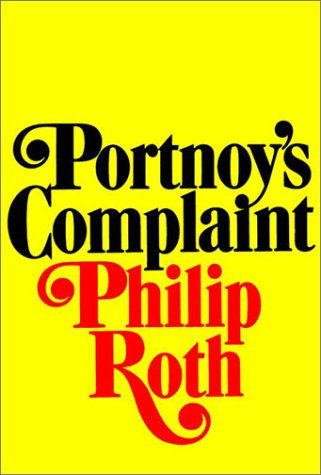
Portnoy's Complaint, as defined by the novels de facto preface:
"A disorder in which strongly-felt ethical and altruistic impulses are perpetually warring with extreme sexual longings, often of a perverse nature... neither fantasy nor act issues in genuine sexual gratification, but rather in overrideing feelings of shame and the dread of retribution."
The eponymous Alexander Portnoy, like Roth, is the son of Jewish parents living in a Jewish community in Newark. The story is told as a long monologue, delivered by Portnoy to his psychoanalyst, Dr. Spielvogel. The novel focuses on Portnoy's attempts to reconcile or move past his ethnic background as a twentieth-century American, and his sexual development and obsessions, and how the former affects the latter.
Portnoy is critical of his Jewish culture in the novel, in a way that is self-aware and very frank. He points out many hypocrisies and idiosyncrasies of Jewish American culture, all of which are exhibited by Portnoy's family. Portnoy declares "This is my life, my only life, and I'm living it in the middle of a Jewish joke! I am the son in a Jewish joke -- only it ain't no joke!" (39-40). The Jewish mother stereotype is the most prevalent, with Portnoy's mother alternately lavishing praise on young Alexander and disowning him for any failures.
This last plays into the psychoanalysis aspect of the story, where many of the tropes of psychoanalytic theory (e.g. "Tell me about your mother...") blown to ridiculous proportions.
Portnoy at one point declares "I am the Raskolnikov of jerking off -- the sticky evidence is everywhere!" Even when discussing masturbation (which Roth does, a lot), there is a strange and effective combination of the high brow and the vulgar. The narrative voice, with its extreme self-consciousness and self-analysis, is one of the major attributes of Portnoy's Complaint that save it from being merely well-written smut. I won't go into great detail on the sexual escapades of Alexander Portnoy. To merely summarize them would take a couple thousand words. Besides the masturbation and the psychological havoc caused by Portnoy's guilt over it, the most important aspect would be Portnoy's relationship with a girl nicknamed "The Monkey."
Through this relationship, Porntoy's background (as a Jew dating a shikse), his sexual obsessions, and his current status (as a successful lawyer-turned-public-figure dating a semi-literate former model) come to a head and lead to near catastrophe.
This is a fantastic book, but it's easy to get distracted by the convoluted sexual fantasies and weird masturbation. While some authors try to make sex and masturbation beautiful, Roth pushes it in the other direction (not violent and horrifyingly depraved as in something like American Psycho, more of a reveling in the filth kind of way).
Roth's previous success with Goodbye, Columbus, combined with the controversy surrounding Portnoy, guaranteed its commercial success.
Portnoy's Complaint was given a film adaptation in 1972, which met with largely negative reviews. According to a review by Roger Ebert: "How could Philip Roth's saga of masturbation have been made into anything but an X-rated movie?...To be sure, Roth's subject and approach was in bad taste -- but in magnificently bad taste...When you try to handle bad taste in good taste, you almost always wind up with something truly obscene."

Portnoy's Complaint has since been added to Modern Library's list of the 100 best novels of the 20th century and TIME magazine's list of the 100 best novels since 1923.
If copious amounts of masturbation and long rants about sex and Jewish mothers liable to offend you, you probably shouldn't read this novel. Otherwise, I recommend it highly.
Bestselling novels of 1969:
1. Portnoy's Complaint by Philip Roth
2. The Godfather by Mario Puzo
3. The Love Machine by Jacqueline Susann
4. The Inheritors by Harold Robbins
5. The Andromeda Strain by Michael Crichton
6. The Seven Minutes by Irving Wallace
7. Naked Came the Stranger by Penelope Ashe
8. The Promise by Chaim Potok
9. The Pretenders by Gwen Davis
10. The House on the Strand by Daphne du Maurier
Also published in 1969:
The Edible Woman by Margaret Atwood
The Very Hungry Caterpillar by Eric Carle
The French Lieutenant's Woman by John Fowles
The Left Hand of Darkness by Ursula Le Guin
Ada or Ardor by Vladimir Nabokov
Slaughterhouse-Five by Kurt Vonnegut
I Know Why the Caged Bird Sings by Maya Angelou
Sources:
"Philip Roth." Contemporary Authors Online. Detroit: Gale, 2012. Literature Resource Center. Web.
Roth, Philip. Portnoy's Complaint. 1969. New York: Bantam Books, 1970. Print.
Philip Roth (1933- ) was born in the Weequahic neighborhood in Newark, New Jersey, and was the son of first-generation Eastern-European Jewish immigrants. He graduated Weequahic High School in 1950, and went on to receive a degree in English from Brucknell University. From there, he received his Masters in Literature from the University of Chicago in 1955. He met Margaret Martinson the following year, and married her in 1959. During this time, he taught college English courses at institutions including the University of Chicago, University of Iowa, and later Princeton University and the University of Pennsylvania.
In 1959, he published his first book, Goodbye, Columbus, a collection of five stories and a novella, which received considerable critical and popular acclaim, and won the National Book Award. Roth and Martinson split up in 1963. Roth's next to novels, Letting Go (1962) and When She Was Good (1967), were given less attention than his first book. Then he published Portnoy's Complaint. The explicit masturbation throughout the novel made the book incredibly controversial: the book was banned in many U.S. libraries and Australia declared the importation of the book to be illegal. This made Roth a public figure in a way he'd never been before.
In 1990, Roth married his long-time partner, Claire Bloom. The two split up in 1994, and Bloom published an unflattering memoir of their relationship, titled Leaving a Doll's House. Roth's novel I Married a Communist (1998) is seen as being partially based on, and in refutation to, Bloom's accusations.
Roth has published 27 books of fiction and four books of non-fiction. He's won two National Book Awards (Goodbye, Columbus 1959 and Sabbath's Theater 1995), the Pulitzer Prize for fiction (American Pastoral 1997), two National Book Critics Circle Awards (The Counterlife 1986 and Patrimony: A True Story 1991) and is the only writer to win three PEN/Faulkner Awards (Operation Shylock 1994, The Human Stain 2000, and Everyman 2007).
The Book:
Portnoy's Complaint, as defined by the novels de facto preface:
"A disorder in which strongly-felt ethical and altruistic impulses are perpetually warring with extreme sexual longings, often of a perverse nature... neither fantasy nor act issues in genuine sexual gratification, but rather in overrideing feelings of shame and the dread of retribution."
The eponymous Alexander Portnoy, like Roth, is the son of Jewish parents living in a Jewish community in Newark. The story is told as a long monologue, delivered by Portnoy to his psychoanalyst, Dr. Spielvogel. The novel focuses on Portnoy's attempts to reconcile or move past his ethnic background as a twentieth-century American, and his sexual development and obsessions, and how the former affects the latter.
Portnoy is critical of his Jewish culture in the novel, in a way that is self-aware and very frank. He points out many hypocrisies and idiosyncrasies of Jewish American culture, all of which are exhibited by Portnoy's family. Portnoy declares "This is my life, my only life, and I'm living it in the middle of a Jewish joke! I am the son in a Jewish joke -- only it ain't no joke!" (39-40). The Jewish mother stereotype is the most prevalent, with Portnoy's mother alternately lavishing praise on young Alexander and disowning him for any failures.
This last plays into the psychoanalysis aspect of the story, where many of the tropes of psychoanalytic theory (e.g. "Tell me about your mother...") blown to ridiculous proportions.
Portnoy at one point declares "I am the Raskolnikov of jerking off -- the sticky evidence is everywhere!" Even when discussing masturbation (which Roth does, a lot), there is a strange and effective combination of the high brow and the vulgar. The narrative voice, with its extreme self-consciousness and self-analysis, is one of the major attributes of Portnoy's Complaint that save it from being merely well-written smut. I won't go into great detail on the sexual escapades of Alexander Portnoy. To merely summarize them would take a couple thousand words. Besides the masturbation and the psychological havoc caused by Portnoy's guilt over it, the most important aspect would be Portnoy's relationship with a girl nicknamed "The Monkey."
Through this relationship, Porntoy's background (as a Jew dating a shikse), his sexual obsessions, and his current status (as a successful lawyer-turned-public-figure dating a semi-literate former model) come to a head and lead to near catastrophe.
This is a fantastic book, but it's easy to get distracted by the convoluted sexual fantasies and weird masturbation. While some authors try to make sex and masturbation beautiful, Roth pushes it in the other direction (not violent and horrifyingly depraved as in something like American Psycho, more of a reveling in the filth kind of way).
Roth's previous success with Goodbye, Columbus, combined with the controversy surrounding Portnoy, guaranteed its commercial success.
Portnoy's Complaint was given a film adaptation in 1972, which met with largely negative reviews. According to a review by Roger Ebert: "How could Philip Roth's saga of masturbation have been made into anything but an X-rated movie?...To be sure, Roth's subject and approach was in bad taste -- but in magnificently bad taste...When you try to handle bad taste in good taste, you almost always wind up with something truly obscene."
Portnoy's Complaint has since been added to Modern Library's list of the 100 best novels of the 20th century and TIME magazine's list of the 100 best novels since 1923.
If copious amounts of masturbation and long rants about sex and Jewish mothers liable to offend you, you probably shouldn't read this novel. Otherwise, I recommend it highly.
Bestselling novels of 1969:
1. Portnoy's Complaint by Philip Roth
2. The Godfather by Mario Puzo
3. The Love Machine by Jacqueline Susann
4. The Inheritors by Harold Robbins
5. The Andromeda Strain by Michael Crichton
6. The Seven Minutes by Irving Wallace
7. Naked Came the Stranger by Penelope Ashe
8. The Promise by Chaim Potok
9. The Pretenders by Gwen Davis
10. The House on the Strand by Daphne du Maurier
Also published in 1969:
The Edible Woman by Margaret Atwood
The Very Hungry Caterpillar by Eric Carle
The French Lieutenant's Woman by John Fowles
The Left Hand of Darkness by Ursula Le Guin
Ada or Ardor by Vladimir Nabokov
Slaughterhouse-Five by Kurt Vonnegut
I Know Why the Caged Bird Sings by Maya Angelou
Sources:
"Philip Roth." Contemporary Authors Online. Detroit: Gale, 2012. Literature Resource Center. Web.
Roth, Philip. Portnoy's Complaint. 1969. New York: Bantam Books, 1970. Print.
Subscribe to:
Posts (Atom)