Monday, February 16, 2015

1998: The Street Lawyer by John Grisham

The Author:


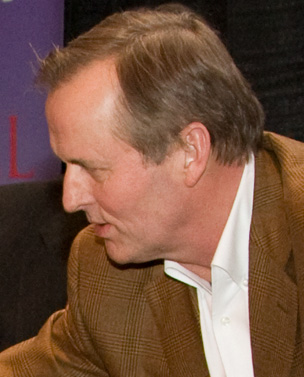
John Grisham (1955-    ) was born in Jonesboro, Arkansas, the son of a construction worker. At the age of twelve, his family moved to Southaven, Mississippi.  He graduated with a B.S. from Mississippi State University in 1979.  He passed the Mississippi Bar exam in 1981, and received his J.D. from the University of Mississippi.  In 1981, he married Renee Jones, with whom he had two children. 

Grisham began a successful law practice in 1981, starting in criminal law, and moving to more lucrative civil law.  In 1984, he was elected to the Mississippi State House of Representatives, a position he held in addition to running his law practice.  A case he witnessed while in the state legislature led him to write his first novel, A Time to Kill (1989).  He had trouble finding an agent and publisher.  He eventually found both, and a limited run of 5,000 copies was printed of his first novel.  In 1990, Grisham resigned from his position on state legislature and retired his practice.  In 1991, Doubleday published his second novel, The Firm.  It was a massive commercial success, as were his third and fourth novels, The Pelican Brief (1992) and The Client (1993).  His fourth book, The Chamber (1994) is the first of eleven novels to become the number one annual bestselling novel in the U.S.

Since 1989, Grisham has published a total of 29 novels, five children's books, and a work of non-fiction.  His family splits its time between homes in Oxford, Mississippi, Charlottesville, Virginia, and Chapel Hill, North Carolina.  Grisham also serves as a board member on the Innocence Project.  


The Book:


1st edition cover


Length: 348 pages
Subject/Genre: Homelessness PSA/Legal thriller

Michael Brock was an up-and-coming anti-trust lawyer on his way to a partnership in a big DC firm, then the unthinkable happened.  A homeless man barged into the law office and held several of the lawyers hostage, including Brock.  He then berated them for their heartlessness towards the more needy, before mentioning something about an eviction and having his head blown off by a police sniper.  This may sound like the beginning of Quentin Tarantino's A Christmas Carol, but is really the impetus for what Grisham presents as a serious look at the plight of the homeless.    

First, let me say that the plight of the homeless isn't a joke, and that a society with more than enough food and resources to care for all its members and still doesn't needs to take a good long look in the mirror.  Michael Brock, after his harrowing experience, contacts the 14th street legal clinic, who represented the kidnapper previously.  He agrees to volunteer at a homeless shelter with a lawyer from the clinic, where he meets an adorable child and his family.  Said child and family freeze to death soon after, leading Brock to take steps in seeking justice.  This is one big problem I have with the novel.  Pretty much every character exists solely to spur on Brock's development, with no real motivation of their own.  His relatives are one-dimensional success-oriented cardboard cutouts, the homeless characters are extras borrowed from The Fisher King, and Michael Brock is a Scrooge-like persona, sliding from 'self-centered rich yuppie' to 'beleaguered defender of the downtrodden.'  For a book that clearly presents itself as having a clear moral purpose (helping the homeless), the homeless play a pretty small part in it.  It's about the brave lawyer turning down a promising career as a soulless attache to the rich in favor of becoming a brave lawyer with a heart of gold.  He further undermines his own point by focusing the plot on a criminal conspiracy against a group of homeless people, which, while it allows for a happy ending where they stick it to the man, detracts attention from the completely legal ways in which our current system is unjust.  Despite some sentimental speeches about society's apathy, the majority of the novel paints the altruistic lawyer as the salvation of America's homeless, at the same time relieving the readers of the sense of responsibility the novel is supposed to instill.  

I realize I'm being pretty harsh, but let me say that it's a good thing Grisham used his reach as a public figure to draw attention to a good cause.  As a novel, it's better than last week's The Partner as well as The Testament (which I'll review next Monday).  If you have some insatiable urge to read a Grisham novel, and this is the only one available, go right ahead.  Otherwise, skip it.

Bestsellers of 1998:

1. The Street Lawyer by John Grisham
2. Rainbow Six by Tom Clancy
3. Bag of Bones by Stephen King
4. A Man in Full by Tom Wolfe
5. Mirror Image by Danielle Steel
6. The Long Road Home by Danielle Steel
7. The Klone and I by Danielle Steel
8. Point of Origin by Patricia Cornwell
9. Paradise by Toni Morrison
10. You Belong to Me by Mary Higgins Clark

Also Published in 1998:

The Hours by Michael Cunningham
The Love of a Good Woman by Alice Munro
The Wind-Up Bird Chronicle by Haruki Murakami
Holes by Louis Sachar

Friday, February 13, 2015

Competitive Bad Writing

It's one thing to make fun of unintentionally bad writing.  There's Philosophy and Literature's famous, if short lived, bad writing contest, in which they highlight the worst in published academic writing, with the stated goal of exposing the use of technical jargon and impenetrable syntax as disguises for lack of insight.  Since 1993, Literary Review has awarded their annual 'bad sex in fiction' award.  Winners(?) of that honor include heavyweights like Tom Wolfe (for I Am Charlotte Simmons) and Norman Mailer (for The Castle in the Forest).  But, like the Razzies for film, these are awards for unintentional bad writing.  No one sets out to write a book or publish an essay with the goal of winning one of these awards.  No, it's a special kind of contest that gets people to produce wretched content on purpose.  

The first big, annual, bad-writing contest I could find began in 1977 and ran to 2005.  Originally a promotional even for Harry's American Bar & Grill, The International Imitation Hemingway Contest, also known simply as the Bad Hemingway Contest, was a runaway success, prompting submissions from amateurs and famous writers alike.   Here's an example from the 1986 winner, The Snooze of Kilimanjaro by Mark Silber:

Now he would never write the things he had saved to write until he learned to spell them. For instance, accommodation. One C, two Ms, or the other way around? He wasn’t sure. Or chrysanthemum? On rugged Kilimanjaro, there was not even a dictionary.

“How do they know I’m dying?” he asked the woman, indicating the crowd of undertakers, florists and wake caterers who were gathering at the edge of the campsite. “Is it the odor?”

“Of your poop?” she asked. “Or your poetry?”

She knew how to hurt him this woman, this female being, this person of the nonmale persuasion. And he would have hurt her back, at least challenged her to a thumb wrestle, if he hadn’t felt it just then. The cold stale breath.

Death.


 Presumably inspired by the IIHC's success, the Faux Faulkner award was created in 1989.  (Both the Hemingway and Faulkner awards were later sponsored by United Airlines, which ended its sponsorship of both in 2005.)  Perhaps the most prestigious extant bad-writing award is the Bulwer-Lytton fiction contest.  Edward George Bulwer-Lytton was a Victorian novelist, whose novel Paul Clifford (1830) infamously begins with the line: It was a dark and stormy night...  The Bulwer-Lytton, run by the English Department at San Jose State University, has been giving out their annual prize since 1982.  Winners produce the worst first lines to novels from a variety of genres.  The 2014 winner:

  When the dead moose floated into view the famished crew cheered – this had to mean land! – but Captain Walgrove, flinty-eyed and clear headed thanks to the starvation cleanse in progress, gave fateful orders to remain on the original course and await the appearance of a second and confirming moose. Elizabeth (Betsy) Dorfman, Bainbridge Island, WA    

Or one of my favorites from this year, the winner of the purple prose category: 

Cole kissed Anastasia, not in a lingering manner as a connoisseur might sip a glass of '82 La Pin, but open-mouthed and desperate, like a hobo wrapping his mouth around a bottle of Strawberry Ripple in the alley behind the 7-11. -- Terri Meeker, Nixa, MO   

Typically, bad-writing contests seem to be named 'in honor of' specific writers, and take on the tone of good-natured joking rather than mockery.  While the Bulwer-Lytton is the only major annual bad-writing contest I know of that's still giving out prizes, smaller once-off contests pop up frequently.  Enjoy the following video, in which Neil Gaiman reads the winners of a special Bad-Gaiman contest.


Wednesday, February 11, 2015

The Shapes of Stories (Part 2)

A while ago I posted a video from Kurt Vonnegut's famous "Shapes of Stories" lecture.  In the decades following the lecture, we've seen the rise of what's been dubbed the 'digital humanities.'  This doesn't refer to hyptertext fiction or anything like that, but rather the use of mathematical algorithms to process data, often from thousands of books at once.  The Paris Review has a great write-up on Matthew Jockers' process of doing what Vonnegut tried to do when he was studying at the University of Chicago: figure out how plots are shaped, and just how many different shapes there are.  A more technical write-up can be found on Jockers' blog.

                                                                                                                                                                from matthewjockers.net

Monday, February 9, 2015

1997: The Partner by John Grisham

The Author:


John Grisham (1955-    ) was born in Jonesboro, Arkansas, the son of a construction worker. At the age of twelve, his family moved to Southaven, Mississippi.  He graduated with a B.S. from Mississippi State University in 1979.  He passed the Mississippi Bar exam in 1981, and received his J.D. from the University of Mississippi.  In 1981, he married Renee Jones, with whom he had two children. 

Grisham began a successful law practice in 1981, starting in criminal law, and moving to more lucrative civil law.  In 1984, he was elected to the Mississippi State House of Representatives, a position he held in addition to running his law practice.  A case he witnessed while in the state legislature led him to write his first novel, A Time to Kill (1989).  He had trouble finding an agent and publisher.  He eventually found both, and a limited run of 5,000 copies was printed of his first novel.  In 1990, Grisham resigned from his position on state legislature and retired his practice.  In 1991, Doubleday published his second novel, The Firm.  It was a massive commercial success, as were his third and fourth novels, The Pelican Brief (1992) and The Client (1993).  His fourth book, The Chamber (1994) is the first of eleven novels to become the number one annual bestselling novel in the U.S.

Since 1989, Grisham has published a total of 28 novels, four children's books, and a work of non-fiction.  His family splits its time between homes in Oxford, Mississippi, Charlottesville, Virginia, and Chapel Hill, North Carolina.  Grisham also serves as a board member on the Innocence Project.


The Book:


first edition cover


Length: 366 pages
Subject/Genre: crime/legal thriller

The Partner begins in a small town in Brazil, when an American living under an assumed name is kidnapped and tortured for information.  His girlfriend/accomplice, a Brazilian lawyer, quickly hides the $90 million that the bad guys are looking for, and alerts the FBI of the man's whereabouts.  The FBI takes custody of the man, and brings him back to Biloxi for trial.  The crime?  After faking his own death, Patrick Lanigan stole the aforementioned $90 million from his law firm.  There are now only two questions: "Where's the money" and "whose body is buried in Lanigan's grave?"  

The Partner is very similar to The Runaway Jury.  Lanigan, like Easter, is running an elaborate plan, all the details of which are known only by him and his girlfriend on the outside.  There's the amoral thugs-for-hire agency, and the crooked corporations bankrolling them.  Most of the novel is just Lanigan slowly revealing how he committed his crimes while his master plan unravels.  He hires an old lawyer friend to represent him.  For no good reason, Lanigan withholds information from the lawyer.  Or rather, there is a reason, but the reason is Grisham's, not Lanigan's.  The only reason to keep reading The Partner is to find out what the plan was, which requires Lanigan to keep secrets he has no reason to keep.  Character is sacrificed to plot.  A little common sense and critical thinking and most of the plan will become pretty obvious, making this the most boring of the Grishams I've read so far.

As opposed to the earlier Grisham novels I reviewed, this one doesn't take a stance on a moral issue like The Chamber, or reflect the social/legal issues of exploitative insurance companies or cigarette manufacturers, as in The Rainmaker or The Runaway Jury.  While there is corruption, it's mostly limited to a high level scam that would seem more at home in a Ludlum or Clancy novel.  The Partner is pretty much a paint-by-numbers legal thriller.

Unless you're a Grisham completist or you're engaged in a project like mine, don't bother with The Partner.  Even if you're a legal thriller devotee, pick another Grisham.

Bestsellers of 1997:

1. The Partner by John Grisham
2. Cold Mountain by Charles Frazier
3. The Ghost by Danielle Steel
4. The Ranch by Danielle Steel
5. Special Delivery by Danielle Steel
6. Unnatural Exposure by Patricia Cornwell 
7. The Best Laid Plans by Sidney Sheldon
8. Pretend You Don't See Her by Mary Higgins Clark
9. Cat and Mouse by James Patterson
10. Hornet's Nest by Patricia Cornwell

Also Published in 1997:

Tuesdays with Morrie by Mitch Albom
The Diving Bell and the Butterfly by Jean-Dominique Bauby
Underworld by Don DeLillo
Mason & Dixon by Thomas Pynchon
American Pastoral by Philip Roth
Harry Potter and the Philosopher's Stone by J. K. Rowling


Friday, February 6, 2015

Review: Old Twentieth by Joe Haldeman (2005)


Joe Haldeman is best known for his fantastic SF novel The Forever War (1974) which won both the Hugo and Nebula for best novel.  He's and SFWA grandmaster, with five Nebulae and five Hugos (Hugii?) under his belt, the most recent for his 2004 novel Camouflage.   

Old Twentieth seems a synthesis of a few major speculative concepts. The first is a society that is practically immortal. You can set your age to stop advancing at any point you wish, and causes of death are limited to catastrophic injuries.  The second is an interstellar journey.  Eight-hundred volunteers in five ships embark on a thousand-year journey to a planet orbiting Beta-Hydrii.  The third is virtual reality, a fully immersive 'time machine' that will let you experience any year or situation within a safe construct.  The fourth is the rise of true artificial intelligence, in this case, that of the VR time machine, which may or may not be responsible when people begin to die while using it.  It's up to our protagonist/narrator, Jacob Brewer, a 200-something year old VR engineer to figure it out.  Before it's too late.    

Let me start with the positive.  There are numerous scenes from within the 'time machine,' depicting everything from a WWI battlefield, to a romantic encounter in Barcelona, to a day spent strolling through the NYC World's Fair.  These segments are fantastic and wonderfully written. Haldeman's writing is strong throughout, but really shines in these chapters.   

But as a whole, the novel was a letdown, especially compared with the quality of Haldeman's other works.  If you read the list of premises on thought it seemed like a bit too much, you might be right. Or rather, it was a bit much for the book's length.  None of the premises get dealt with in depth, and the book just shuttles through the plot.  For example:   

Immortality.  The novel gives the backstory that the Becker-Cendrek process was initially extremely expensive, leading to a massive civil war and culminating in the death of everyone not already immortalized.  The society that forms in the war's wake is pretty standard sci-fi futurism.  Population control via test-tube babies, cyber-ennui, etc.  The point being, beside some minor details, immortality isn't a significant factor in this culture.  They think of death the same way we do, it's just less frequent.  But in a society where the only cause of death is violent, couldn't death become obscene or taboo?  In a society where there is no death, might it be romanticized (I might draw some argument here, but the romanticizing of death in this society is no greater than it is in ours).   If the only cause of death is serious bodily damage, wouldn't a section of society become reclusive, the only thing standing between them and eternal life accident or malice?  Wouldn't there be a population of hedonists, with no need to worry about disease or health?  Would we have a society where individuals become so specialized communication becomes challenging, or would everyone be a Renaissance man, versed in science and the arts?  Instead of anything like the above, we get a pretty standard future-world, where people just happen to live a really-really-really long time.  

All in all, Old Twentieth was a fun read, but it bit off a lot more than it could chew. 


Sunday, January 4, 2015

Review: Timequake by Kurt Vonnegut (1997)


Timequake is Kurt Vonnegut's last novel.  Vonnegut himself is the narrator, alternating between personal anecdotes, descriptions of the process of writing Timequake, and scenes from the timequake and the last few years of Kilgore Trout's life.  A Timequake is a brief contraction of the universe, that causes a preceding interval of time (in this case 10 years) to be played over again, exactly as it had been before.  Except everyone has their memories of the last time round.

Timequake is one of the two post-Breakfast of Champions novels I'd recommend to anyone who isn't a die-hard Vonnegut fan  (the other is Galápagos). Vonnegut's career is interesting because there is a very clear midway point (or perhaps an apexe) in the form of Breakfast of Champions (1973).   It was around this time that he published his last short story, "The Big Space Fuck" in the Harlan Ellison edited anthology Again, Dangerous Visions (1972).  If you're familiar with the ending of Breakfast, it isn't that surprising.  Technically, stylistically, and philosophically, his first six novels all built up to Breakfast of Champions.  His remaining novels, even the ones I recommended at the beginning of this paragraph, fit into an identical mould.

For one, the characters are all completely passive.  While this is true of his earlier novels, it's taken to a new extreme in his later. As Vonnegut himself advised "Every character needs to want something, even if it is just a glass of water."  Generally speaking, his later protagonist/narrators don't even want that. They just want to be left alone, but not badly enough to do anything about it.  Additionally, the format of the novels is 'written record left by the protagonist.'  This is not inherently bad (cf. Mother Night and Cat's Cradle), but it just retreads a lot of the same ground.  The structure of the novels is the same as well, a non-chronological cycling back and forth between the time of the character's writing the story and the events narrated, each time adding a little more while constantly hinting at some mystery/cataclysm just over the horizon (e.g. what's in Bluebeard's shed? What happened to Midland? Why was he arrested? etc.).  Galápagos and Timequake succeed despite this, the former because of an clever and engaging premise, the latter because Vonnegut can be at his best when he writes about himself.  

While I would still recommend any of the first seven novels to Timequake, it's definitely worth a read if you have a copy lying around.


Monday, December 15, 2014

1996: The Runaway Jury by John Grisham

The Author:


John Grisham (1955-    ) was born in Jonesboro, Arkansas, the son of a construction worker. At the age of twelve, his family moved to Southaven, Mississippi.  He graduated with a B.S. from Mississippi State University in 1979.  He passed the Mississippi Bar exam in 1981, and received his J.D. from the University of Mississippi.  In 1981, he married Renee Jones, with whom he had two children.

Grisham began a successful law practice in 1981, starting in criminal law, and moving to more lucrative civil law.  In 1984, he was elected to the Mississippi State House of Representatives, a position he held in addition to running his law practice.  A case he witnessed while in the state legislature led him to write his first novel, A Time to Kill (1989).  He had trouble finding an agent and publisher.  He eventually found both, and a limited run of 5,000 copies was printed of his first novel.  In 1990, Grisham resigned from his position on state legislature and retired his practice.  In 1991, Doubleday published his second novel, The Firm.  It was a massive commercial success, as were his third and fourth novels, The Pelican Brief (1992) and The Client (1993).  His fourth book, The Chamber (1994) is the first of eleven novels to become the number one annual bestselling novel in the U.S.


Since 1989, Grisham has published a total of 28 novels, four children's books, and a work of non-fiction.  His family splits its time between homes in Oxford, Mississippi, Charlottesville, Virginia, and Chapel Hill, North Carolina.  Grisham also serves as a board member on the Innocence Project.  


The Book:

1st edition cover


Length: 401 pages
Subject/Genre:litigation/legal thriller

In typical Grisham fashion, The Runaway Jury focuses on a trial in Mississippi, in this case, a product liability suit in Biloxi against the Pynex tobacco company.  Like his previous novel, The Rainmaker, this is a story of an unpopular, corrupt, and powerful organization being fought down in the courtroom.  As you might expect, the tobacco companies are in cahoots to prevent a plaintiff´s verdict, fearing future litigation, and they don't play by the rules.  The lavishly funded Rankin Fitch does all there dirty work outside the court.  But in this case, something else is afoot.  One juror, who goes by the name Nicholas Easter, isn't who he says he is.  And with outside help from the mysterious Marlee, it's clear he's setting himself up to swing the jury whichever way he wants.  But whether for profit or private motivation is unknown...

A little context.  I've frequently compared Grisham novels to episodes of Law & Order, and this included the ripped-from-the-headlines premises.  Tobacco litigation was reaching a peak in the 1990s, with not only individuals, but states suing the tobacco industry.  In 1994, Mississippi became the first of over 40 states to sue the manufacturers for health care costs incurred by the state.  And, as opposed to the individual cases, the states were having a good degree of success in the courts.  In an interesting sidenote, two years after The Runaway Jury  was published, the tobacco industry and the U.S. government entered the Tobacco Master Settlement Agreement.  In essence, the tobacco companies pay billions to the states and fund some anti-smoking non-profits, meanwhile the states don't sue and private lawsuits against the tobacco companies become more difficult.

I have trouble reviewing Grisham novels because they're always pretty much what they appear on the surface.  It's like reviewing an episode of CSI, where the only meaningful yardstick is other episodes of the same or similar shows.  Grisham is entertaining, easy and quick to read, and you know exactly what you´ll get going in.  Curled up on a bunk bed in Rome with a bad cold, Grisham was a good choice.  But I feel like I keep having to reiterate that he keeps approaching interesting questions and grand themes but always stops short and doesn't actually explore them at all.  The plot of The Runaway Jury would be great for discussions about things like the difference between legal justice and moral justice, and whether corruption can fight corruption.  But of course this is left to the reader as an exercise.  

The Runaway Jury was adapted for the screen in 2003.

"Drop the 'the.'  It's cleaner."

The films starred Gene Hackman, Dustin Hoffman, John Cusack, and Rachel Weisz.  It also replaces the cigarette companies with gun manufacturers. 


Anyway, as I think I'll be repeating a lot in the upcoming reviews, if you want something light and entertaining, feel free to read a Grisham novel.  If not, don't.  Also, go watch Thank You for Smoking.


Bestsellers of 1996:

1. The Runaway Jury by John Grisham
2. Executive Orders by Tom Clancy
3. Desperation by Stephen King
4. Airframe by Michael Crichton
5. The Regulators by Stephen King
6. Malice by Danielle Steel
7. Silent Honor by Danielle Steel
8. Primary Colors by Anonymous
9. Cause of Death by Patricia Cornwell
10. The Tenth Insight by James Redfield 

Also Published in 1996:
Midnight in the Garden of Good and Evil by John Berendt
Bridget Jones' Diary by Helen Fielding
A Game of Thrones by George R. R. Martin
Fight Club by Chuck Palahniuk
Infinite Jest by David Foster Wallace


Sources:

Grisham, John. The Runaway Jury. New York: Doubleday, 1996. Print.